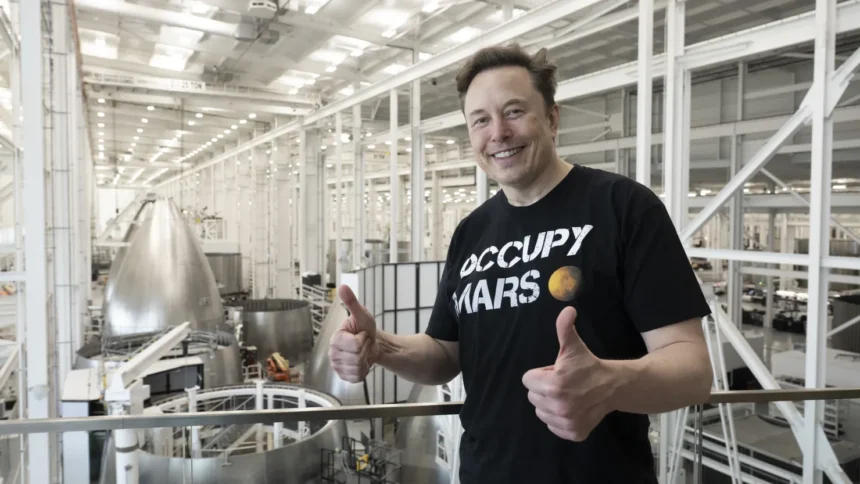
SpaceX published an updated IPO prospectus on Wednesday, pricing its upcoming offering at $135 a share for a total valuation of approximately $1.77 trillion, with 555.6 million shares on offer and $75 billion to be raised in what would be the largest initial public offering in market history by a wide margin – and the specific number attached to Elon Musk’s stake, $866.5 billion in paper value based on the offering price, is the figure that NewsTrackerToday flagged as the analytical anchor for the trillionaire question. Add Musk’s $350 billion-plus stake in Tesla, and his total paper wealth crosses $1.2 trillion before the SpaceX IPO has even priced on the market. Forbes currently lists his net worth at $826 billion, placing Larry Page of Google in a distant second below $300 billion. The gap is not close.
The SpaceX IPO supersedes Saudi Aramco’s 2019 listing as the largest in history. It arrives 16 years after Musk took Tesla public, a company he did not found but whose value he built to its current market capitalization of approximately $1.35 trillion. SpaceX, which he did co-found in 2002, has grown from a rocket startup into a multi-vertical enterprise: Starlink, the commercial satellite internet business that generated $11.4 billion in revenue and $4.4 billion in operating income in 2025, is the largest single revenue contributor. The Starship program, still in test-flight phase, is the growth driver. The xAI business, merged into SpaceX in February when both were valued at a combined $1.25 trillion, now sits inside the offering.
Liam Anderson makes the financial case bluntly: “Largest IPO in history. $75 billion raised. $1.77 trillion valuation. If it prices and trades, Musk clears a trillion in net worth on day one. That’s not speculation anymore, it’s the math from the prospectus.” Tesla’s share price rose 14% in May, contributing meaningfully to the run-up. SpaceX’s Starlink revenue alone compares favorably to the revenue of most S&P 500 companies. The combined enterprise is structured to list on a major U.S. exchange with trading expected to begin as early as June 12. The specific capitalization structure and lock-up provisions in the prospectus, which govern when Musk and early employees can actually sell shares, are what NewsTrackerToday ran through as the detail that separates paper wealth from liquid wealth in this context.
Isabella Moretti examines the transaction mechanics: “The xAI merger changes the deal’s character in a way that gets under-examined. SpaceX at the time of the merger was valued at roughly $1 trillion. xAI was $250 billion. The merged entity is seeking a $1.77 trillion IPO valuation. That’s a significant premium over the sum-of-parts. Investors are paying for synergy between Starship’s physical infrastructure, Starlink’s recurring revenue, and xAI’s AI model development. Whether those three businesses compose into a value greater than their parts is the core underwriting question that IPO day will begin to answer.”
The comparative context matters for calibrating the headline. Saudi Aramco, whose 2019 listing raised $25.6 billion at a $1.7 trillion valuation, remained substantially state-controlled and never traded as a pure market instrument. SpaceX enters the market as a company whose growth depends on Elon Musk’s continued operational leadership, his access to government contracts including NASA’s Artemis program, and the commercial success of Starlink in a market where regulatory licenses and spectrum allocations create genuine barriers to competition. Concentration of control, lock-up structures, and Musk’s 42% ownership stake with voting majority are the governance features that NewsTrackerToday put on record as the material disclosures institutional buyers will price against the headline valuation.
The SpaceX IPO opens on a market that has priced in most of the upside already through private secondary transactions that valued the company at progressively higher marks throughout 2025 and early 2026. The question for investors buying at $135 is not whether SpaceX is a consequential company – it clearly is – but whether the $1.77 trillion that the offering assigns to it reflects the full range of execution risks in Starship development, regulatory dependencies, and the AI business’s competitive position. What the next trading sessions will read, and what News Tracker Today reads as the first real test of this valuation, is whether the price holds or whether the lock-up period disclosure creates selling pressure from early holders who have waited years for exactly this liquidity event.