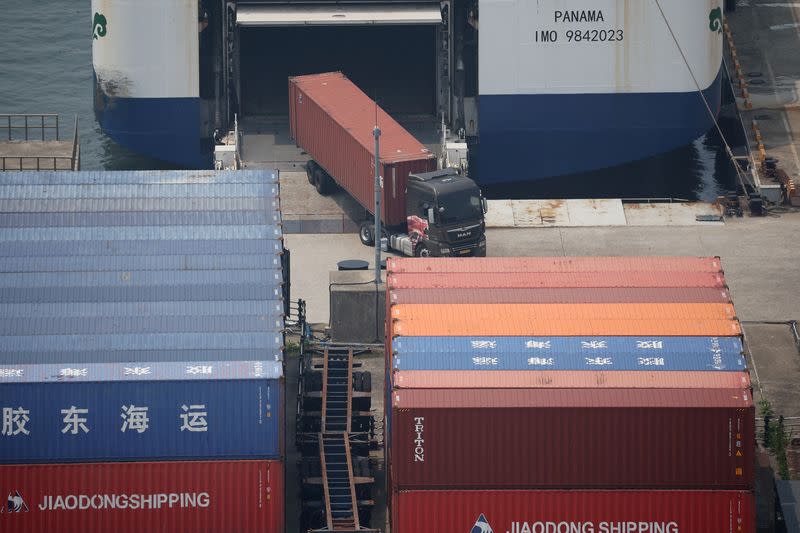
South Korea’s export data for May arrived on Monday morning and it is the kind of number that requires a second read – the specific figure, and the four-decade context around it, being the combination that NewsTrackerToday opened with as the lead for this story. Exports rose 53.2% year-on-year to a record high of $87.75 billion, against a median forecast of 48.4% growth and against a backdrop that makes the number even more remarkable: it is the strongest annual export growth rate since January 1984. Semiconductor exports drove the headline, jumping 169.4% year-on-year to a record monthly high of $37.16 billion. Computer sales surged 290.7% on AI server demand. Petroleum products rose 46.6% on elevated oil prices. Automobile exports fell 5.9% on supply disruptions and the impact of U.S. tariffs. The KOSPI hit a record high on Monday morning, rising more than 2% in early trade.
The semiconductor number is the structural story. South Korea’s two dominant memory chip makers, Samsung Electronics and SK Hynix, have been the primary suppliers of high-bandwidth memory for the AI server build-out that has run at extraordinary pace throughout 2025 and into 2026. HBM prices have risen sharply as hyperscalers, cloud providers, and increasingly enterprise buyers compete for supply. The $37.16 billion in May semiconductor exports is not a one-month anomaly: it is the output of a sector that built its production capacity over decades and is now capturing the AI-driven demand wave at the moment of peak pricing leverage. The KOSPI index has risen more than 100% year to date, led almost entirely by chip sector performance, with last year’s 76% gain the prior reference point.
Liam Anderson calls the trade data clean: “169% semiconductor export growth in a single month. That’s not a cyclical recovery. That’s a structural demand shift. SK Hynix and Samsung are the HBM suppliers that matter. The pricing environment and the order backlog both support this continuing through at least Q3. The KOSPI is pricing it correctly.” Stephen Lee, an economist at Meritz Securities in Seoul, described the pace as “truly unprecedented, raising market expectations again and again and exceeding them again and again.” He forecast full-year export growth of around 50% and raised his 2026 GDP growth estimate to above 2.6%. South Korea’s central bank, which raised its growth forecast the prior week to 2.6% from 2.0%, looks likely to revise again when it updates its projections. That revision cycle is what NewsTrackerToday documented as the secondary signal: consecutive central bank upgrades within weeks of each other indicate the AI chip demand is not just a trade story but a macroeconomic one.
Daniel Wu draws the geopolitical context: “South Korea runs the most exposed version of the AI chip trade dynamic: almost total dependence on global demand for memory semiconductors, highly concentrated in two companies, in a geopolitically sensitive location that sits between the U.S. and Chinese technology spheres. The 53.2% export growth is a bonanza, but it comes with a structural fragility. If hyperscaler AI spending slows or if Chinese domestic chip production reduces import dependence on Korean memory, the exposure flips. Korea ran this playbook with DRAM in the late 1990s. The 2000 correction was brutal. The question is whether this cycle ends differently because HBM is structurally more complex to replicate than DRAM was.”
Automobile exports falling 5.9% deserves its own attention alongside the chip euphoria. Hyundai and Kia are two of South Korea’s largest non-chip exporters, and the combination of Middle East supply disruptions and U.S. tariff exposure created specific headwinds in May. The tariff dimension – which the South Korean government has been actively negotiating with Washington – also sits as a risk to the chip export trajectory: U.S. export controls on advanced semiconductor equipment and materials tightened further in 2025, and any escalation into memory chips specifically could pressure the very category driving May’s record number. That policy risk is what NewsTrackerToday read against the headline as the forward variable the data itself cannot capture.
The most credible near-term projection is continued strength. Stephen Lee at Meritz Securities expects momentum to hold into Q3 and full-year growth to land around 50%. The central bank’s upgraded GDP forecast of 2.6% gives room for a further revision if the chip demand trajectory holds through the second half of 2026. The June export data, due in early July, will be the first read on whether May’s 53.2% represents a new baseline or a peak driven by particularly favorable base effects. HBM supply is still constrained, hyperscaler capital expenditure guidance remains elevated, and Samsung is running its memory fabs at capacity. The scenario that News Tracker Today maps as the most likely near-term path is sustained double-digit growth rather than acceleration, with the specific trajectory depending on whether enterprise AI infrastructure spending holds the pace set by hyperscalers or begins to moderate.