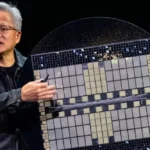
In global technology, rare moments of clarity emerge when market dynamics, capital flows and executive rhetoric align into a single trajectory. Jensen Huang’s speech in South Korea was one of those markers. As artificial intelligence shifts from a software tool to an industrial production force, Nvidia is solidifying its position as the architectural core of the new digital economy. At NewsTrackerToday, we do not see this as a flashy statement but as a strategic declaration: AI no longer belongs solely to the world of code. It has entered the realm of physical capital, industrial capability and economic infrastructure.
Huang underscored that the industry has entered a new regime of self-reinforcing growth. More capable models stimulate higher usage, adoption leads to profitability, profits fuel new data-center construction, and those facilities produce even more advanced models. According to him, the feedback loop is already in motion. At NewsTrackerToday, we define this as the arrival of computational-priority economics, where expansion is no longer tied to application demand, but to the capacity to build and scale compute.
Appearing not in his signature black leather jacket but in a business suit, Huang framed what Big Tech has already begun confirming through earnings: capital expenditure on artificial intelligence is entering a multi-year expansion cycle. Meta, Amazon, Alphabet, and Microsoft expect cumulative AI infrastructure spending to exceed 300 billion dollars, with momentum accelerating into 2026. Ethan Cole, chief macro analyst at NewsTrackerToday, notes that this scale evokes historical industrial build-outs. In his view, the logic mirrors the steel expansion cycles of the 20th century: when profitability and technological edge converge, capital flows without hesitation.
Huang drew a direct line between AI and chip manufacturing cycles, stressing that profit inevitably triggers factory construction. Almost simultaneously, Nvidia revealed its partnership with Samsung, which will deploy a 50,000-GPU cluster to accelerate development of mobile and robotics semiconductors. This is not a routine procurement; it is the birth of an industrial-grade AI factory. Sophie Leclerc, technology analyst, highlights that AI is now moving from cloud-only environments into production floors. As she puts it, the competitive battlefield is shifting away from model launches and keynotes toward physical execution, iteration speed and supply-chain resilience.
Huang stated that a decade-long overhaul of computing has begun. After sixty years of relative architectural continuity, every layer of the stack is being rewritten: energy demands, silicon, system software, AI models and real-world applications. And the trillion-dollar legacy computing base, he argued, must migrate to accelerated platforms. At NewsTrackerToday, we interpret this as the formal end of the CPU-first era and the official beginning of accelerated computing as the economic foundation of AI.
Context only sharpens the message. Nvidia recently became the first company to surpass 5 trillion dollars in market valuation. This is more than a symbolic milestone; it is confirmation that compute capacity now rivals traditional strategic assets in value. We are entering an economy of Excess Compute Capability, where competitive power rests not on promises but on electricity supply agreements, cooling contracts, GPU allocation rights and enterprise readiness to integrate models into physical operations.
Two conclusions emerge clearly. First, the next chapter of AI will be measured not by novelty but by productivity gains, cost savings, throughput improvements and error reduction. Second, governments and corporations that fail to secure energy, infrastructure and operational AI skill-sets risk relegation to the technological periphery. For enterprises, this means restructuring roadmaps, budgeting for hybrid AI stacks and building diversified vendor portfolios. For investors, it means focusing on the enablers of computational infrastructure, not only on the model layer.
And for the global market, it signals the end of any illusion that AI is a hype cycle. At News Tracker Today, we are convinced: the decade ahead belongs not to those who merely experiment with AI, but to those who operationalize it, industrialize it and align their financial systems to computational reality. Those who move now will anchor the industries of the future. Those who wait may discover that the barrier to entry has already moved beyond reach.