Elon Musk has once again pushed humanoid robots into the market spotlight, framing them as a cornerstone of Tesla’s long-term valuation and hinting at a future measured in tens of trillions of dollars. Yet as NewsTrackerToday observes, Tesla’s Optimus remains a concept-driven narrative rather than a commercial product, with no visible path to scaled production or near-term revenues.
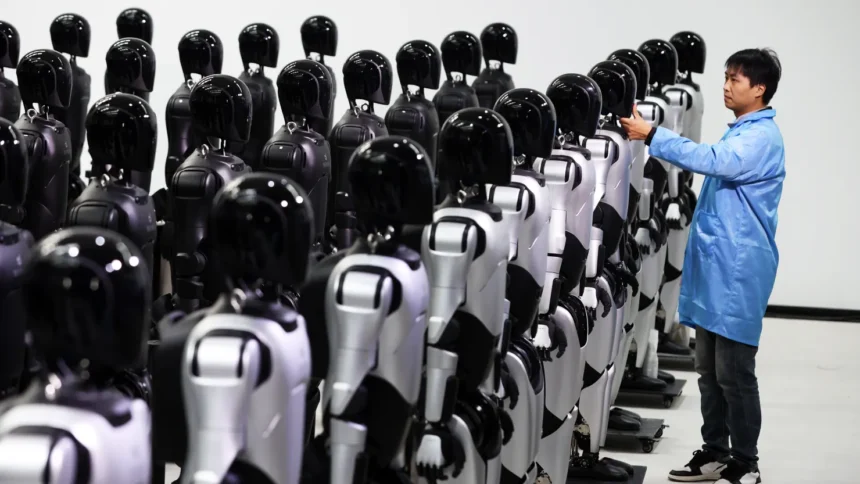
While Optimus stays in prototype mode, momentum is quietly shifting east. Across China, humanoid robotics is moving from spectacle to execution, supported by industrial policy, manufacturing depth, and a willingness to scale before perfection. The result is not necessarily smarter robots, but cheaper, faster, and more reproducible ones – a distinction that matters once commercialization begins. At the core of this divergence is strategy. In the U.S., humanoid robots are largely framed as AI-first systems – software intelligence wrapped in hardware. In China, they are treated as industrial assets, designed to slot into factories, logistics hubs, and service environments even with limited autonomy. NewsTrackerToday notes that this framing lowers the threshold for deployment: robots do not need to be human-like in cognition if they are economically useful in constrained tasks.
Sophie Leclerc, technology sector analyst, argues that the early phase of the humanoid market will reward industrial discipline over technical elegance. “The first commercial winners won’t be the most advanced robots,” she says. “They will be the ones that factories can afford, maintain, and replicate at scale without collapsing margins.” Chinese firms are already testing that thesis. Companies such as Unitree, UBTech, and AgiBot are shifting focus from demonstrations toward production targets, while automakers like Xpeng are leveraging existing supply chains to enter the space. This mirrors earlier patterns seen in electric vehicles and battery manufacturing, where cost curves fell rapidly once scale became the priority.
News Tracker Today highlights that China’s advantage is not limited to labor costs. Dense supplier ecosystems allow rapid iteration of motors, actuators, sensors, and control systems. Combined with local government incentives and pilot programs, this creates an environment where humanoid robots can move from lab to factory floor with fewer delays. The United States, by contrast, retains leadership in core AI models, autonomy, and system-level integration. American firms emphasize vertical control – owning the stack from algorithms to hardware – to protect intellectual property and performance. However, this approach is capital-intensive and slower to scale, potentially leaving U.S. players exposed during the market’s first commercial wave.
Daniel Wu, geopolitics and energy expert, views humanoid robotics as the next arena where industrial policy and technology competition will collide. “Once humanoid robots become manufacturable at scale, they stop being a tech novelty and start behaving like strategic infrastructure,” he notes. “That’s when export controls, chip access, and supply chains turn into competitive levers.”
Despite the optimism, risks are mounting. Production costs for advanced humanoids remain high, fine motor control is still unreliable, and safety and regulatory frameworks are underdeveloped. Chinese regulators themselves have warned of speculative excess, with dozens of firms chasing similar designs and investor expectations running ahead of real-world capability. For investors and policymakers alike, the next two years will be decisive. The key question is not which robot looks most human on stage, but which company can drive costs down fast enough to make deployment rational. NewsTrackerToday expects 2026 to mark the beginning of that test – not a consumer robot boom, but the first serious trial of humanoids as industrial products.
The broader implication is clear.If China succeeds in turning humanoid robots into scalable, economically viable machines before others do, it may once again define the manufacturing standard for a new technology cycle. As NewsTrackerToday concludes, the humanoid race is no longer about vision alone – it is about who can industrialize the future first.