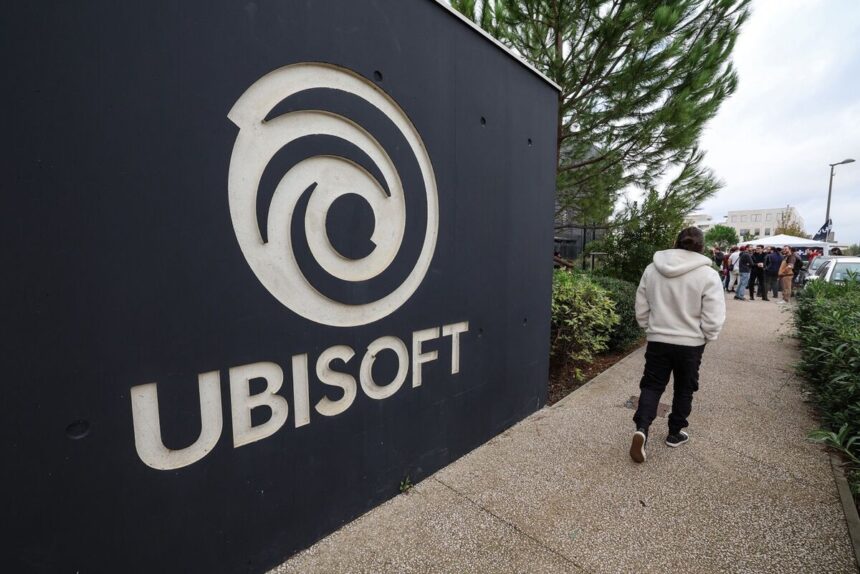
After years of strategic drift, Ubisoft is entering a decisive reset phase – and the market reaction makes clear that patience has run thin. The publisher’s shares collapsed by 34% following the announcement of a sweeping internal reorganization, a sharp signal that investors now expect measurable execution rather than long-term restructuring narratives, a shift closely tracked by NewsTrackerToday.
The company confirmed plans to reorganize operations into five creative divisions, each with full responsibility for development pipelines, budgets, and commercial outcomes. At the same time, Ubisoft will cancel six projects and delay seven others, a move management describes as necessary to refocus resources on fewer, higher-conviction franchises. From an analytical standpoint, this reflects a late but unavoidable acknowledgment: Ubisoft’s legacy multi-studio structure had become too fragmented to sustain predictable delivery in an increasingly hit-driven market.
The financial implications were more severe than expected. Ubisoft now forecasts an operating loss of roughly €1 billion for the fiscal year ending in 2026, including asset impairments of approximately €650 million tied to canceled and postponed titles. Net bookings guidance was revised down to about €1.5 billion, reinforcing concerns over near-term revenue visibility. News Tracker Today views this write-down not as a one-off anomaly, but as evidence that the company is purging a pipeline built for a demand environment that no longer exists.
Cost discipline is now central to the turnaround narrative. Management targets €500 million in annual cost savings by March 2028, aiming to reduce fixed costs to €1.25 billion from €1.75 billion in fiscal 2023. However, Ubisoft also expects negative free cash flow of €400–€500 million in fiscal 2026, underscoring that financial stabilization will not be immediate. To preserve flexibility, the company reiterated that asset sales remain under consideration – a lever that could ease balance-sheet pressure but also reshape the long-term portfolio. According to Liam Anderson, a financial markets analyst focused on technology and media companies, equity markets are reacting less to the scale of the losses than to uncertainty around timing. In his view, once publishers lose release reliability, valuation frameworks shift toward risk containment rather than growth optionality. That assessment aligns with NewsTrackerToday’s interpretation: Ubisoft is now priced as a restructuring asset, not a growth franchise.
The decision to structurally protect core intellectual property through dedicated operating units further supports this reading. Isabella Moretti, an analyst specializing in corporate strategy and restructuring, notes that such segmentation often serves a dual purpose – improving internal accountability while simplifying future divestments if required. Strategically, this suggests Ubisoft is preparing for multiple outcomes, not a single recovery path.
What determines success from here is execution discipline. Delivery timelines, post-launch performance, and cash burn will matter more than organizational charts. Any further delays could quickly erode the credibility gained by decisive write-downs, while consistent releases could stabilize both revenues and sentiment. By forcing losses into the open and narrowing its focus, Ubisoft has chosen a painful but clearer trajectory. The coming quarters will test whether this restructuring produces operational control or merely buys time. For NewsTrackerToday, the takeaway is direct: this is no longer a turnaround story measured in vision statements, but one that will be judged by delivery dates, cash flow trends, and the resilience of flagship franchises.