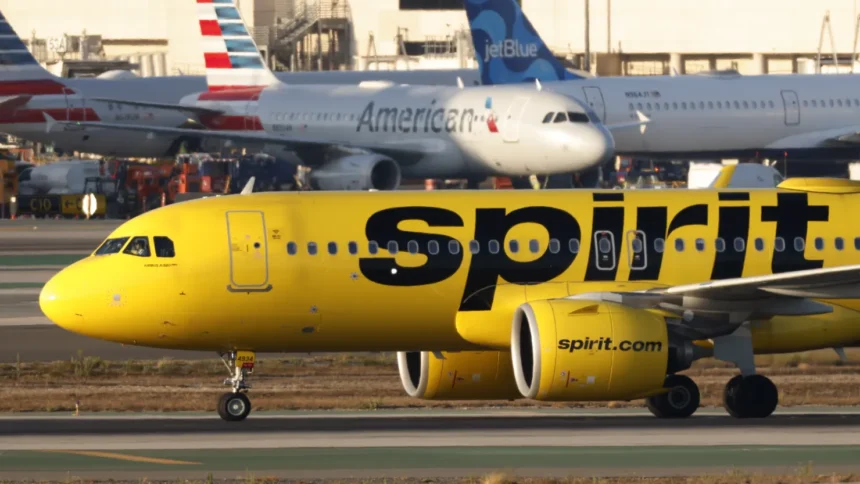
Spirit Airlines’ restructuring effort has entered a decisive phase as the ultra-low-cost carrier explores a potential strategic transaction with aviation-focused investment firm Castlelake while attempting to exit Chapter 11. The discussions come as Spirit faces narrowing liquidity options, structural cost pressure, and a domestic market environment that has become increasingly hostile to pure low-fare models – a dynamic closely monitored by NewsTrackerToday amid broader stress across U.S. aviation.
The airline’s situation reflects more than a cyclical downturn. Spirit has now pursued multiple recovery paths in a compressed timeframe, a pattern that typically signals diminishing tolerance among creditors for incremental fixes. Fleet reductions, route rationalisation and labour concessions have stabilised short-term cash flow, but they have not resolved the core issue: rising unit costs colliding with fare compression in a saturated domestic market. In this context, a capital-led solution may offer greater speed and certainty than a traditional airline merger.
Castlelake’s potential involvement is strategically consistent with its long-standing role in aviation finance and distressed asset restructuring. The firm’s ability to work directly with bondholders and aircraft lessors could allow Spirit to simplify its capital structure while securing transitional funding. According to Isabella Moretti, an analyst specialising in corporate strategy and M&A, the appeal of such a deal lies in execution rather than growth. She notes that when an airline reaches this stage, value preservation depends on restoring creditor confidence and operational predictability before attempting any revenue-side reinvention – a framework News Tracker Today has repeatedly observed in prior airline restructurings.
Operational headwinds remain significant. Spirit has been disproportionately affected by engine availability issues tied to inspections across the A320neo fleet, limiting capacity and forcing delivery deferrals. While these measures protect near-term liquidity, they also constrain network relevance and reduce the airline’s ability to respond to competitive pricing moves by larger peers. The result is a shrinking operational footprint at precisely the moment when scale and scheduling flexibility matter most.
From a macro perspective, the ultra-low-cost segment has lost some of its historical insulation against cost shocks. Ethan Cole, a macroeconomic analyst focused on transportation and capital-intensive industries, argues that labour inflation, maintenance costs and higher financing rates have structurally altered the economics of the model. Without premium cabins, loyalty-driven credit card revenue or international diversification, domestic-focused carriers face limited buffers when costs rise faster than demand. This imbalance, he suggests, explains why financial sponsors – rather than strategic airline buyers – are increasingly central to survival scenarios, a pattern highlighted in NewsTrackerToday’s sector coverage.
Spirit’s long-running association with Frontier underscores the difficulty of airline-to-airline consolidation in the current regulatory climate. While such combinations promise network synergies, they also invite antitrust scrutiny and prolonged approval timelines. A financial restructuring led by an investment firm may therefore offer a faster, lower-risk path, even if it delivers fewer strategic synergies.
The critical variables now are executional. Creditor alignment, access to bridge financing, and the ability to stabilise operations without further erosion of customer confidence will determine whether Spirit can emerge as a viable standalone carrier. For passengers, the impact is likely to be incremental rather than abrupt – fewer frequencies, tighter capacity, and continued emphasis on bundled pricing. For investors and industry observers, the story has shifted decisively from demand recovery to balance-sheet control.
Ultimately, Spirit’s future will hinge on whether it can convert temporary financial relief into durable operational stability. From NewsTrackerToday’s perspective, this is no longer a turnaround defined by market recovery, but a test of whether disciplined capital restructuring can buy the time needed for a structurally challenged airline to reset its role in a changed industry landscape.