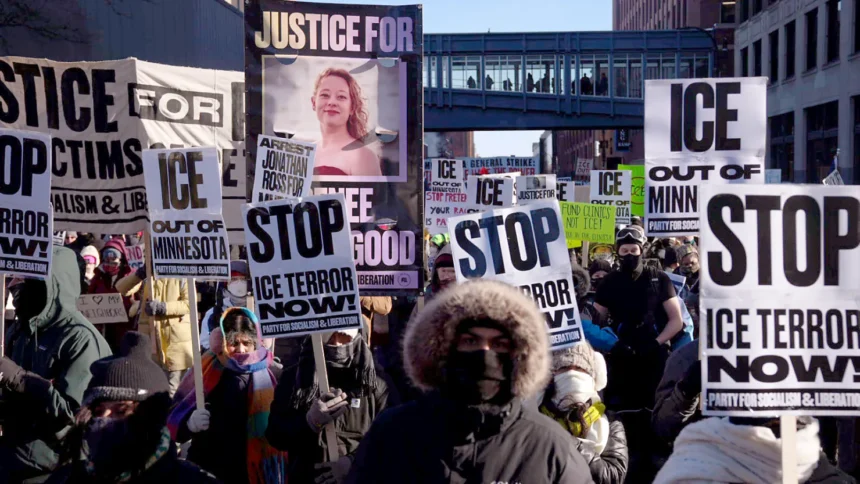
Tensions in Minnesota escalated sharply over the weekend after a fatal shooting involving a federal immigration operation in Minneapolis, an incident that has rapidly evolved from a local tragedy into a national stress test for federal authority, public trust, and political stability – a development closely tracked by NewsTrackerToday amid growing concern over institutional credibility.
The shooting of 37-year-old nurse and U.S. citizen Alex Pretti by a federal immigration agent has triggered conflicting narratives at the highest levels of government. Homeland Security Secretary Kristi Noem characterized the incident as a “defensive” response, while video evidence circulating publicly appears to challenge that account. When official statements diverge from visual records, the issue shifts beyond individual conduct toward systemic legitimacy, increasing the risk of escalation rather than resolution.
Minnesota Governor Tim Walz has urged the White House to halt federal immigration operations in the state, arguing that the deployment of thousands of agents has created instability rather than security. This is the second fatal shooting involving federal agents in Minneapolis this month, intensifying scrutiny over operational oversight, training standards, and rules of engagement. From a governance perspective, NewsTrackerToday views this moment as a collision point between enforcement policy and public accountability, where transparency becomes as critical as authority.
The response from corporate leadership has been unusually direct. Executives tied to major Minnesota-based employers called for immediate de-escalation, emphasizing cooperation and stability without directly naming federal policy. According to Ethan Cole, a macroeconomic analyst specializing in institutional risk, such statements are less about political positioning and more about operational continuity. “When unrest threatens labor availability, retail activity, and supply-chain predictability, corporations act to protect system stability first,” he notes. In this context, executive silence or engagement becomes a measurable signal of perceived risk.
Political fallout is already spreading to Capitol Hill. Congressional Democrats have indicated they may block any federal funding package that includes expanded appropriations for the Department of Homeland Security without structural changes. This raises the probability of a partial government shutdown, a scenario that would compound uncertainty across procurement cycles, regulatory coordination, and investor confidence. NewsTrackerToday identifies this funding standoff as the most immediate secondary risk, with consequences extending well beyond immigration policy itself.
Market dynamics reflect the growing unease. Investors have trimmed exposure to U.S. equities amid geopolitical and domestic uncertainty, while safe-haven assets have surged. Gold recently broke above the $5,100 per ounce level, a move that signals confidence erosion rather than inflation fear. Daniel Wu, an analyst focused on energy and geopolitical systems at NewsTrackerToday, interprets the rally as a hedge against policy unpredictability. “When political outcomes become binary and hard to price, capital moves toward insurance rather than growth,” he explains.
Compounding the pressure, a severe winter storm swept across much of the United States, prompting emergency declarations in over 20 states. The disruption led to thousands of flight cancellations, sharp spikes in natural gas prices, and widespread power outages. Energy markets were particularly strained in regions with high data-center density, where electricity demand exceeded forecasts. These overlapping shocks highlight how climate volatility and infrastructure stress are increasingly intertwined, especially as digital and AI-driven energy consumption accelerates.
Internationally, trade tensions added another layer of complexity. Canada’s prime minister stated that the country does not intend to pursue a free trade agreement with China following threats of punitive tariffs from Washington. Even without formal policy changes, such signaling alone can deter cross-border investment and delay strategic decisions, reinforcing a climate of caution among multinational firms.
Taken together, these developments form a single narrative rather than isolated events. Institutional credibility, market confidence, energy resilience, and political coordination are converging under strain. For investors, the critical variables are no longer limited to earnings or inflation data but include shutdown probability, regulatory coherence, and social stability. For businesses, scenario planning around disruption and communication risk has become essential. As this week unfolds, News Tracker Today will be watching whether Minnesota’s crisis stabilizes through de-escalation – or becomes a broader template for federal-state confrontation in an already fragile environment.