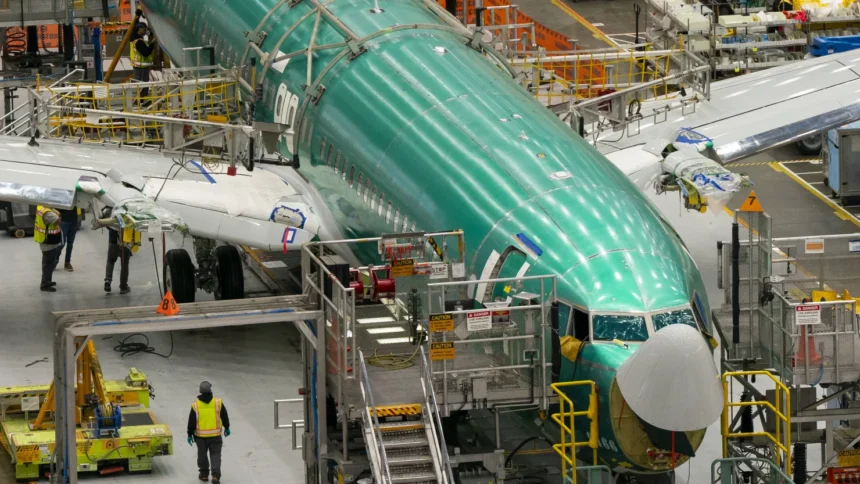
Boeing’s fourth-quarter results signal a fragile but meaningful shift after years of operational disruption, regulatory scrutiny and financial strain. Revenue exceeded market expectations as aircraft deliveries reached their highest annual level since 2018, reinforcing the idea that Boeing is moving out of crisis mode and into a phase of controlled recovery.
Quarterly revenue rose to $23.9 billion, up 57% year-on-year, supported primarily by higher commercial aircraft deliveries. For Boeing, delivery volume remains the decisive financial lever, as most aircraft revenue is recognised at handover rather than order placement. From a NewsTrackerToday perspective, this improvement reflects operational normalisation rather than a return to structural growth.
Operating cash flow reached approximately $400 million, roughly double consensus expectations. Management reiterated guidance for positive free cash flow of $1 billion to $3 billion in 2026, positioning this as an intermediate step toward a longer-term target of $10 billion. NewsTrackerToday notes that this trajectory remains highly sensitive to production stability and regulatory approvals, particularly for the 737 Max programme.
Commercial aircraft revenue surged nearly 140% compared with the prior year, while the defence segment recorded a 37% increase. The simultaneous expansion of both divisions marks a departure from recent quarters, when weakness in one business often offset gains in the other. However, defence programmes continue to face delays and cost pressures, limiting margin visibility despite higher revenue.
Aircraft deliveries totalled roughly 600 units in 2025, nearly double the previous year’s level. While this represents tangible progress, Boeing still trails Airbus, which delivered 793 aircraft over the same period. That said, Boeing outperformed its European rival in net new orders, securing 1,173 compared with Airbus’s 889. According to NewsTrackerToday, this reflects airlines prioritising long-term delivery slots for the 2030s rather than reacting to near-term production volatility.
Regulatory constraints remain the central bottleneck. Boeing has yet to receive approval from the Federal Aviation Administration to raise monthly 737 Max production beyond 42 aircraft. Certification delays also persist for the Max 7, Max 10 and the widebody 777X, limiting Boeing’s ability to fully monetise its order backlog. News Tracker Today views regulatory risk as the dominant factor shaping the pace of recovery, outweighing demand-side concerns.
Net income for the quarter reached $8.22 billion, compared with a significant loss a year earlier. However, this figure includes one-off items, including asset sales, and should not be read as a clean indicator of recurring profitability. Earnings volatility is likely to persist until production volumes and certification timelines stabilise.
Overall, Boeing appears to have exited the most acute phase of its crisis, but the recovery remains conditional. NewsTrackerToday assesses the current phase as one of rehabilitation rather than expansion, where disciplined execution, predictable regulatory engagement and gradual capacity increases will determine whether recent progress translates into durable financial performance.