Chinese technology companies are rapidly accelerating the deployment of new artificial intelligence models as competitive pressure from U.S. players intensifies and the global AI race enters a phase defined less by breakthrough announcements and more by execution speed. As NewsTrackerToday reports, China’s leading developers are shifting focus from headline performance claims toward faster iteration, lower operating costs and deeper integration into existing digital ecosystems.
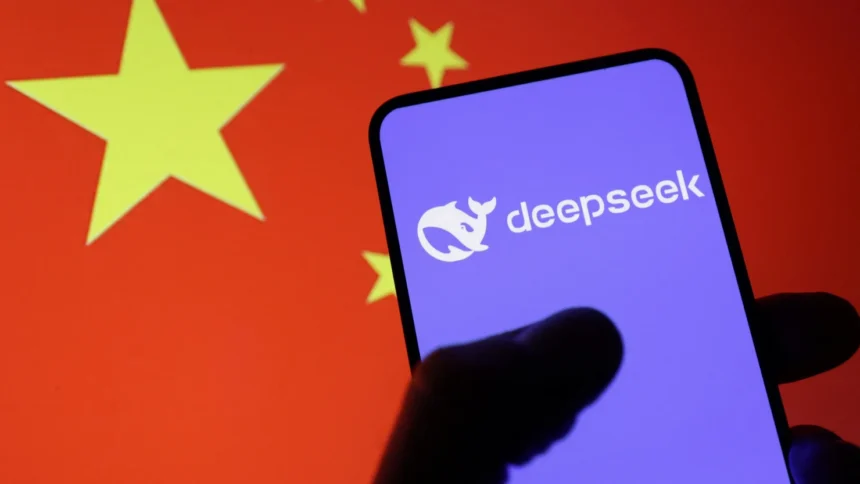
The shift gained global attention more than a year ago, when DeepSeek released an AI chatbot that significantly undercut Western peers on training and inference costs. That moment challenged assumptions about the effectiveness of U.S. export controls and highlighted China’s growing emphasis on efficiency-driven innovation. Since then, the pace of model releases has accelerated, with Chinese firms prioritizing rapid updates and broad user adoption over long development cycles.
This week, Beijing-based Moonshot AI introduced an upgraded version of its Kimi model, emphasizing expanded agent-based capabilities and multimodal generation features. The release followed a previous major update only months earlier, underscoring how compressed development timelines have become. Around the same time, Alibaba rolled out a new iteration of its Qwen platform, positioning it as a general-purpose AI system capable of selecting tools autonomously and generating text, images and video within a single workflow.
From a market-structure perspective, NewsTrackerToday notes that benchmarks are increasingly secondary to distribution. Sophie Leclerc, a technology-sector analyst, observes that models embedded directly into high-traffic platforms gain an advantage that standalone systems struggle to replicate. “The competitive edge is shifting toward where AI lives, not just how it performs,” she notes, pointing to integration with commerce, messaging and payment ecosystems as a key differentiator.
Accessibility is another defining element. Many Chinese models are released with open-source components or low-cost licensing, making them attractive to developers in emerging markets. Usage data suggests this strategy is already influencing adoption patterns outside China, particularly in regions where infrastructure constraints favor lighter, more efficient models.
However, rapid deployment has introduced new operational risks. Z.ai’s recent release of a free version of its GLM model reportedly strained available computing capacity as demand surged, highlighting how infrastructure remains a bottleneck. According to NewsTrackerToday, this tension between user growth and compute availability is likely to intensify as agent-based systems require persistent processing rather than episodic queries.
Geopolitics continues to shape the landscape. Daniel Wu, a geopolitics and energy analyst, notes that while export restrictions limit access to advanced chips, they have also accelerated optimization efforts. “China’s AI sector is adapting by extracting more output per unit of compute,” he explains, adding that long-term scalability will still depend on power supply, memory availability and data-center expansion.
Looking ahead, Chinese AI firms are expected to double down on ecosystem-driven growth. Promotional campaigns tied to major consumer platforms, combined with aggressive pricing, suggest that user acquisition – not pure model supremacy – will remain the primary battlefield. For global enterprises, this creates a more fragmented but flexible AI market, where multiple viable systems coexist rather than a single dominant standard.
The broader takeaway, as News Tracker Today concludes, is that China’s AI strategy is no longer defined by catching up to Western leaders. Instead, it reflects a distinct model centered on speed, cost discipline and distribution leverage – a combination that may prove just as influential as raw technical performance in shaping the next phase of global AI competition.