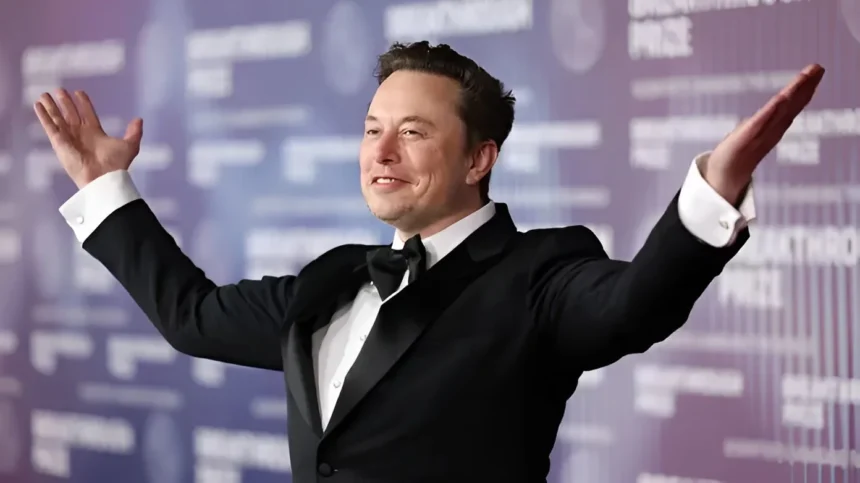
Elon Musk’s path toward becoming the world’s first trillionaire is increasingly shaped by rockets and artificial intelligence rather than electric vehicles. Recent developments around the consolidation of SpaceX and xAI suggest that capital structure, not consumer demand, is now the primary driver of Musk’s personal wealth trajectory. From the perspective of NewsTrackerToday, this marks a structural pivot in how markets should evaluate Musk’s business empire.
According to financial documents reviewed by multiple market participants, the SpaceX–xAI transaction values the combined entity at approximately $1.25 trillion, with SpaceX accounting for the majority of that figure. Musk’s estimated stake of roughly 43% implies personal exposure exceeding $500 billion tied primarily to aerospace, defense contracts, and AI infrastructure. NewsTrackerToday views this concentration as a decisive shift away from Tesla as the central pillar of Musk’s net worth.
Isabella Moretti, an analyst specializing in corporate strategy and mergers, describes the deal as less about operational synergy and more about capital efficiency. In her assessment, folding xAI into SpaceX reframes AI spending as infrastructure investment rather than speculative R&D. That reframing matters because SpaceX benefits from long-term government contracts, predictable cash flows, and strategic relevance in defense and space communications, which can help justify sustained AI capital expenditure without immediate profitability.
The timing is notable. Speculation around a SpaceX public listing has intensified, and this consolidation appears designed to maximize valuation ahead of any liquidity event. NewsTrackerToday notes that combining launch capability, satellite networks, and AI compute into a single narrative could appeal to large institutional investors seeking scale, even if the operational complexity increases. However, that same complexity may reduce transparency, particularly around how much cash flow from aerospace operations is effectively underwriting xAI’s rapid expansion.
From a market-structure standpoint, the risk is not technological but financial. Liam Anderson, a financial markets analyst, argues that public investors are likely to apply a discount to any structure that blends stable government-backed revenue with a capital-intensive AI business lacking near-term returns. He notes that valuation pressure will emerge once depreciation, power costs, and data-center buildouts become more visible in consolidated financials. NewsTrackerToday considers this a key test for any future IPO narrative.
Tesla’s position within Musk’s portfolio now looks increasingly secondary. The automaker has acknowledged that a growing share of Musk’s wealth is generated outside the company, a dynamic that raises governance concerns for public shareholders. While Tesla retains upside optionality tied to automation and robotics, its stock performance has been more volatile, reflecting execution risk and brand uncertainty. NewsTrackerToday interprets this divergence as a signal that Musk’s strategic focus is shifting toward private assets with delayed price discovery.
Regulatory exposure adds another layer of uncertainty. xAI has faced scrutiny related to content moderation and misuse of generative tools, while SpaceX continues to attract attention due to its defense role and international investor base. Although none of these issues currently block corporate action, News Tracker Today emphasizes that cumulative regulatory friction can influence valuation, disclosure requirements, and investor appetite at scale.
The broader implication is clear. The trillionaire narrative depends less on headline valuations and more on financing durability. Investors should expect future catalysts to revolve around capital raises, secondary transactions, or pre-IPO structuring rather than product milestones.
NewsTrackerToday expects markets to increasingly separate Musk’s businesses into distinct risk categories: Tesla as a publicly traded consumer and automation play, and SpaceX–xAI as a private infrastructure and AI capital platform with fundamentally different valuation dynamics.
In that sense, the question is no longer whether Musk can reach a trillion-dollar net worth, but whether markets are willing to fund the balance-sheet complexity required to sustain it.