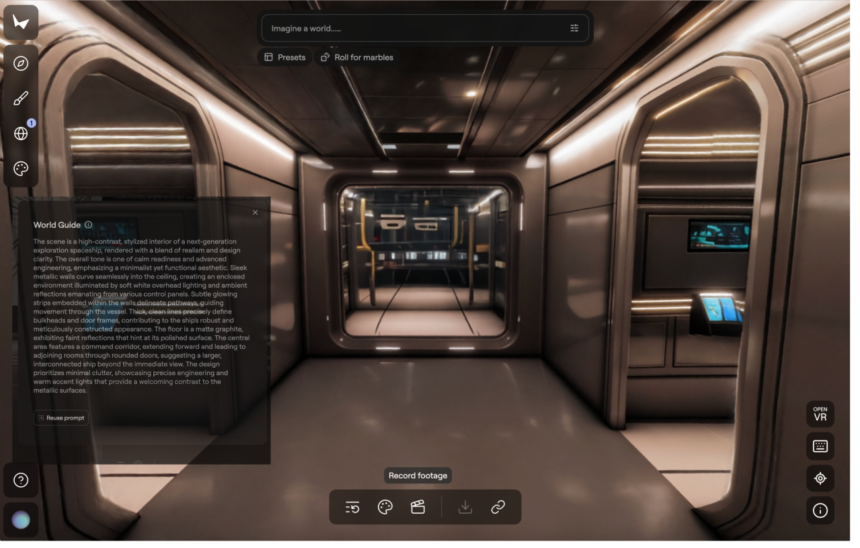
Autodesk is moving beyond incremental AI features and positioning itself at the center of a broader shift toward spatially aware computing. The partnership with World Labs reflects a strategic attempt to fuse generative intelligence with physical-world understanding – an approach that, in our assessment at NewsTrackerToday, signals a long-term infrastructure play rather than a short-term feature update.
At the core of this strategy is Autodesk’s development of “Neural CAD,” a class of generative models trained on geometric and engineering data rather than purely visual content. Unlike image-based AI systems, these models are designed to generate functional 3D components and assemblies that respect constraints, tolerances, and system relationships. Sophie Leclerc, technology sector specialist, notes that the competitive advantage will not come from novelty but from reliability – tools that shorten iteration cycles while maintaining engineering integrity will command durable enterprise demand. In NewsTrackerToday’s view, this shifts AI in design from experimentation to operational leverage.
World Labs adds another dimension: world modeling and spatial intelligence. Where Neural CAD focuses on object-level geometry, world models aim to understand environmental context – space, interaction, and physical dynamics. The combination has implications beyond product design, extending into architecture, construction, simulation, robotics environments, and digital twin ecosystems. Isabelle Moretti, corporate strategy and M&A specialist, argues that partnerships of this kind are less about headline innovation and more about expanding platform defensibility. Embedding AI deeply into existing workflows increases switching costs and strengthens enterprise lock-in.
Autodesk has already begun integrating Neural CAD capabilities into its architecture and engineering portfolio, signaling a transition from isolated AI features to more systemic integration. NewsTrackerToday observes that this layered approach – geometry reasoning, system simulation, and contextual modeling – mirrors the broader evolution of enterprise AI from task automation to structured decision support.
Strategically, this development aligns with a wider industry push toward models that do more than generate outputs. The next phase of enterprise AI requires systems capable of aligning semantic understanding with spatial and physical constraints. As one executive noted, useful AI must understand worlds, not just words. That framing reflects a structural shift: language models handle abstraction, but engineering and industrial workflows demand grounded, constraint-aware intelligence.
From a forward-looking perspective, the key questions will revolve around execution. Can Autodesk translate Neural CAD into measurable productivity gains without introducing design risk? Can world-model integration reduce downstream friction in permitting, compliance, and construction planning? News Tracker Today expects early adoption among high-complexity enterprise clients where iteration speed directly affects capital allocation decisions.
The broader implication is clear. If Autodesk succeeds in merging geometry-native generative systems with world-aware spatial modeling, it strengthens its position as an AI-enabled infrastructure platform rather than a software vendor experimenting with automation. If execution lags, competitors leveraging open ecosystems may narrow the differentiation gap.
In structural terms, this is not a product announcement – it is a positioning move within the next phase of applied AI. NewsTrackerToday will continue monitoring how deeply these capabilities integrate into real workflows and whether they deliver quantifiable performance improvements across engineering lifecycles.