Nvidia enters a defining phase in the AI infrastructure race as attention shifts from quarterly earnings to its next-generation rack system, Vera Rubin. While current results are expected to show strong sales growth for existing platforms, the strategic narrative centers on whether Vera Rubin can reinforce Nvidia’s dominance in an increasingly competitive, power-constrained environment. As NewsTrackerToday emphasizes in its semiconductor coverage, the AI cycle now revolves around energy efficiency and system-level architecture rather than standalone chip performance.
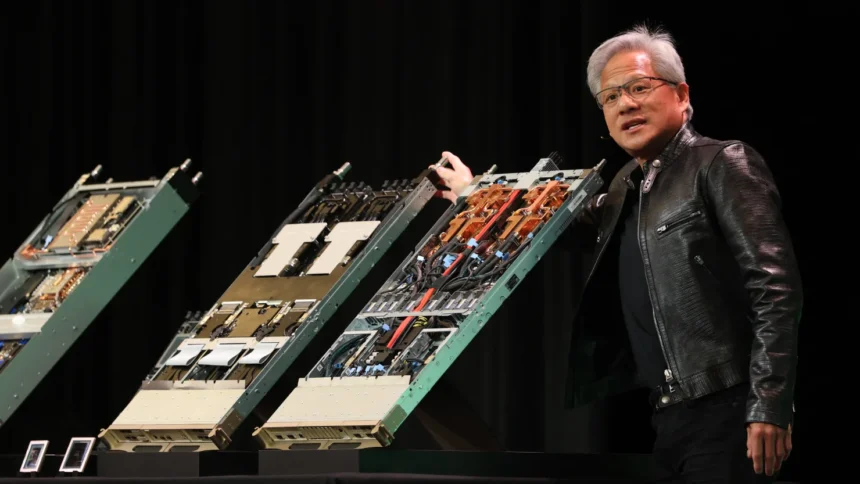
Vera Rubin integrates 72 Rubin GPUs and 36 Vera CPUs within a single rack-scale system comprising approximately 1.3 million components. Nvidia positions it as delivering up to 10 times the performance per watt of Grace Blackwell. That metric matters more than peak throughput alone. Liam Anderson, financial markets expert, notes that “in hyperscale infrastructure, performance per watt directly influences return on invested capital.” As data centers approach grid capacity limits, efficiency becomes a financial variable rather than a technical footnote.
Although Vera Rubin consumes more total power than its predecessor, its significantly higher output per watt shifts the economics of inference and training workloads. Ethan Cole, chief economic analyst specializing in macroeconomics and central banking, argues that “compute markets now operate under energy constraints, not silicon constraints.” Operators increasingly measure value in tokens generated per unit of electricity, aligning hardware decisions with long-term cost discipline.
The system also introduces full liquid cooling, a departure from hybrid or air-based architectures. That shift enables higher density deployments and reduces reliance on traditional evaporative cooling methods. As NewsTrackerToday has previously analyzed, thermal management now represents a strategic differentiator in AI infrastructure buildouts. Efficient cooling allows hyperscalers to maximize compute per square meter without escalating operational risk.
Vera Rubin’s global supply chain spans more than 80 suppliers across at least 20 countries. Nvidia continues expanding U.S.-based production capacity, including Blackwell manufacturing at new TSMC facilities in Arizona, as part of a broader strategy to mitigate geopolitical exposure. Such diversification strengthens resilience but increases logistical complexity – an execution factor investors will monitor closely.
Pricing estimates suggest rack costs between $3.5 million and $4 million, approximately 25% above Grace Blackwell. However, hyperscale buyers prioritize total cost of ownership over sticker price. If the claimed efficiency gains materialize in production environments, higher upfront costs may translate into superior capital returns. As NewsTrackerToday underscores, system economics – not component pricing – now determine competitive advantage.
Competitive pressure continues to mount. AMD’s forthcoming Helios rack system, proprietary silicon from Google and Amazon, and specialized accelerators from Broadcom all reflect a growing multi-vendor strategy among hyperscalers. Customers seek secondary supply channels to reduce dependency on Nvidia and maintain pricing leverage. Yet Nvidia retains a powerful moat through its software ecosystem and integration depth.
Over the next 12 to 24 months, execution will define leadership. If Vera Rubin delivers on performance-per-watt claims and integrates smoothly into large-scale deployments, Nvidia will extend its infrastructure cycle dominance. If competitors close the efficiency gap, market share may fragment more rapidly. As News Tracker Today continues to evaluate, the AI race has evolved into a contest of scalable, energy-optimized systems – and Vera Rubin stands at the center of that transition.