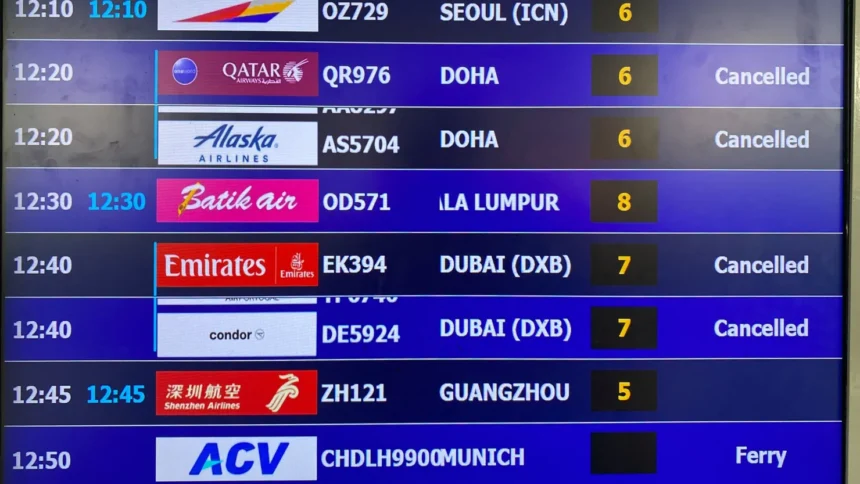
Airline and travel stocks slid sharply after Middle East airspace closures forced carriers to cancel thousands of flights, disrupting global routes far beyond the region. What began as a regional security measure quickly evolved into a cross-sector market reaction affecting airlines, cruise operators, and broader leisure equities. As NewsTrackerToday highlights, travel markets respond not only to immediate disruptions but to the duration and unpredictability of geopolitical risk.
More than 11,000 flights have been canceled across or into the Middle East in the wake of escalating tensions, affecting over a million passengers within days. The operational fallout extends beyond lost ticket revenue. Airlines must reposition aircraft, reassign crews, process rebookings, and absorb customer service costs. Daniel Wu, geopolitics and energy analyst, explains that “aviation disruptions amplify quickly because hub airports function as global multipliers.” When major transit hubs such as Dubai or Tel Aviv pause operations, ripple effects extend across Europe, Asia, and the Americas.
Oil prices also moved higher, compounding pressure on airline margins. Fuel remains one of the largest cost components after labor, and even modest price increases reshape forward earnings expectations. Liam Anderson, financial markets expert, notes that investors price scenarios, not spot conditions. “Markets discount extended disruption immediately. If traders anticipate weeks rather than days of volatility, valuations adjust before quarterly numbers reflect it,” he says.
Cruise operators experienced parallel declines, even though cruise routes do not rely directly on Middle Eastern airspace. That reaction underscores a broader psychological mechanism: when geopolitical risk intensifies, consumers tend to defer discretionary travel spending. NewsTrackerToday observes that leisure demand operates on confidence as much as logistics. Elevated uncertainty often suppresses booking momentum across the entire travel ecosystem.
The timing complicates matters because international travel had been a relative bright spot. Industry data earlier this year showed international passenger demand rising nearly 6% year over year, while domestic demand remained relatively flat. That momentum supported airline revenue resilience. However, prolonged instability in major transit corridors threatens that recovery narrative, particularly for long-haul and premium international routes.
Airlines with significant international exposure face the most immediate vulnerability. Suspension of high-margin routes, combined with rerouting inefficiencies and higher fuel costs, compresses margins quickly. News Tracker Today emphasizes that execution discipline now differentiates carriers. Companies that manage crew logistics, maintain transparent rebooking policies, and communicate clearly with customers will mitigate reputational damage and financial strain more effectively.
Looking ahead, three variables will shape the sector’s trajectory: the duration of airspace restrictions, the direction of oil prices, and consumer confidence in booking forward travel. If closures remain short-lived, deferred demand could produce a rebound through rebookings. If instability persists, markets may apply a sustained risk discount to travel equities. As NewsTrackerToday assesses, in periods of geopolitical turbulence, operational resilience – not growth projections – becomes the primary driver of investor confidence.