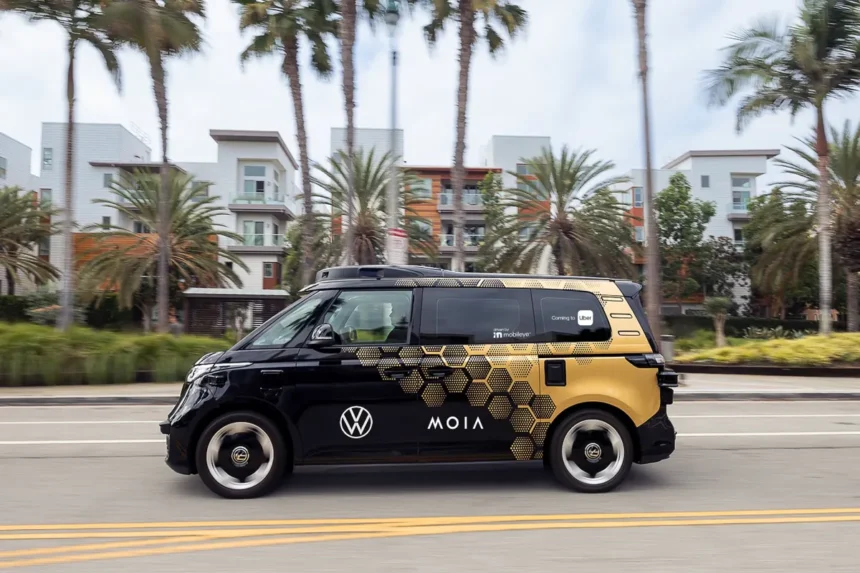
Volkswagen’s mobility unit MOIA America and Uber have begun real-world testing of autonomous electric microbuses in Los Angeles, marking a decisive step toward a planned commercial robotaxi launch by late 2026. The move signals a transition from concept to execution in a market long defined by car culture, and as NewsTrackerToday notes within industry circles, Los Angeles increasingly serves as a proving ground for next-generation mobility models.
The initial rollout will involve around 10 autonomous versions of the Volkswagen ID. Buzz, with capacity for four passengers per vehicle. While modest in scale, the pilot reflects a broader ambition: Volkswagen aims to expand the fleet beyond 100 vehicles over time, building operational density before removing safety drivers entirely – a milestone now projected for 2027. A joint operational hub already established in Los Angeles underscores the companies’ intent to move quickly from testing into structured deployment.
This initiative sits within a wider strategic recalibration at Volkswagen. The rebranding of its U.S. autonomous division to MOIA America aligns it more closely with its European operations, where ride-pooling and autonomous trials have already generated valuable operational data. Isabella Moretti, who focuses on corporate strategy and M&A, views the move as an attempt to unify fragmented mobility efforts under a single scalable framework – one that integrates software, fleet management, and urban deployment into a coherent business model.
Uber’s role adds another layer of complexity. Rather than building proprietary systems, the company continues to assemble a diversified portfolio of autonomous partnerships, spanning multiple geographies and technologies. In this context, the MOIA collaboration complements existing alliances such as Waymo in the U.S. and Wayve in Europe. NewsTrackerToday highlights how this platform-based approach allows Uber to hedge technological risk while maintaining control over user demand and network effects – a structure that mirrors its earlier expansion in ride-hailing.
Financial commitments reinforce that direction. Uber’s recent agreement with Rivian – involving a $300 million investment and plans to deploy 10,000 autonomous vehicles by 2028 – signals that scale remains the ultimate objective. Liam Anderson, specializing in financial markets, points out that capital allocation in this sector increasingly favors long-term positioning over near-term profitability, as companies compete to secure infrastructure advantages in urban mobility ecosystems.
Regulatory constraints, however, remain a critical variable. Before any commercial robotaxi service can operate in California, MOIA America must secure approvals from both the Department of Motor Vehicles and the Public Utilities Commission. These processes often extend timelines and introduce uncertainty, particularly as safety standards evolve alongside the technology itself. Still, momentum appears to be building, and NewsTrackerToday continues to track how regulatory adaptation could either accelerate or constrain deployment across key U.S. cities.
What emerges from the Los Angeles pilot is not just a localized experiment, but a signal of intensifying competition in autonomous mobility. Volkswagen brings manufacturing scale and engineering depth, while Uber contributes platform reach and demand aggregation. Together, they are testing whether a hybrid model – combining industrial capability with digital infrastructure – can succeed where earlier autonomous ventures struggled. News Tracker Today frames this moment as a shift from isolated trials to coordinated ecosystem development, where execution speed and regulatory navigation will determine who captures the next phase of urban transport.