Nvidia has obtained U.S. approval to sell its H200 artificial intelligence accelerators to roughly ten of China’s most influential technology groups, but the authorization has yet to produce a single shipment. What appeared to be a breakthrough for the world’s dominant AI chipmaker remains frozen in bureaucratic and political uncertainty, leaving billions of dollars in potential revenue stranded between two superpowers that increasingly treat semiconductors as instruments of national strategy rather than ordinary exports.
The approved customer list reportedly includes Alibaba, Tencent, ByteDance, and JD.com. Additional authorization has been granted to distributors such as Lenovo and Foxconn. Under current licensing terms, each approved buyer may purchase as many as 75,000 H200 chips – enough computing capacity to support large-scale AI training, cloud inference, and enterprise deployments. NewsTrackerToday sees in this unusual situation a vivid example of how regulatory approval no longer guarantees commercial execution when strategic interests collide.
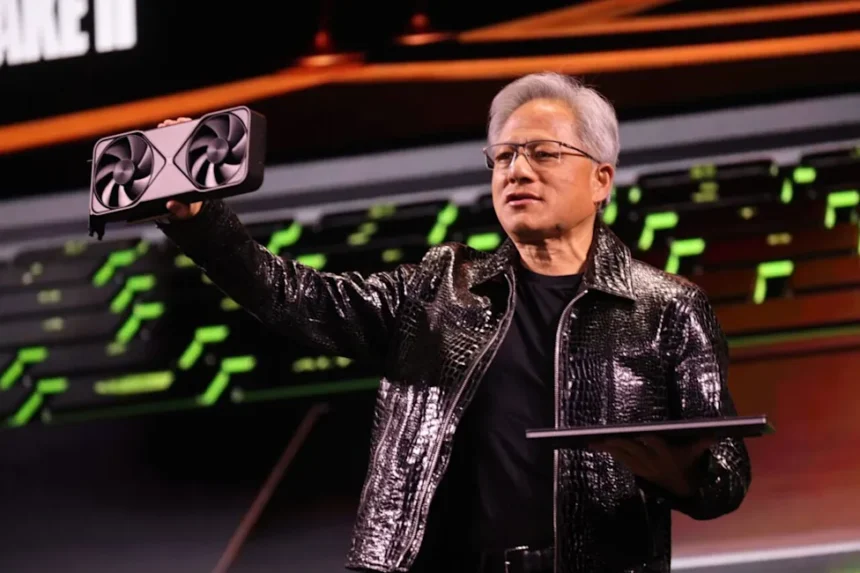
China has long been one of Nvidia’s most consequential markets. Before export restrictions tightened, the company controlled roughly 95% of China’s advanced AI accelerator segment. The country once accounted for 13% of Nvidia’s revenue, and Jensen Huang has estimated that China’s AI market alone could be worth $50 billion this year. Those figures explain why Huang chose to join Donald Trump on a high-profile trip to Beijing, signaling that access to China remains a strategic priority even as political tensions intensify.
For Nvidia, the Chinese market represents more than short-term sales. It offers scale, long-term customer relationships, and continued influence over the technical standards that shape the global AI ecosystem. If Chinese firms are forced to build entirely around domestic alternatives, Nvidia risks losing not only revenue but also its role as the foundational supplier to one of the world’s largest computing markets. NewsTrackerToday draws a direct line between Huang’s diplomatic efforts and the company’s determination to prevent that strategic erosion.
Despite Washington’s approval, Beijing has reportedly encouraged domestic companies to proceed cautiously. Chinese officials appear concerned that renewed purchases of Nvidia hardware could weaken the national push to develop indigenous semiconductor capabilities. Huawei has emerged as the most prominent beneficiary of this policy shift, with its AI processors increasingly positioned as a patriotic and strategic alternative to American technology.
Although Huawei’s chips still lag Nvidia in raw performance, the competitive gap is narrowing. More importantly, Chinese policymakers may view a somewhat less powerful domestic solution as preferable to dependence on a foreign supplier vulnerable to shifting export controls. Sophie Leclerc notes that this reflects a broader transformation in the semiconductor industry, where purchasing decisions are now driven as much by sovereignty concerns as by benchmark performance.
The mechanics of the proposed transactions add another layer of complexity. Chinese buyers must certify strong security procedures and guarantee that the processors will not be used for military purposes. Nvidia must maintain sufficient inventory inside the United States. In addition, the Trump administration negotiated an arrangement under which Washington would receive 25% of the resulting revenue, forcing the chips to pass through U.S. territory before being shipped to China. NewsTrackerToday identifies in this structure a striking example of how commercial contracts are being redesigned to serve geopolitical objectives.
Resistance is growing in both capitals. Beijing has tightened supply chain security rules and intensified efforts to reduce foreign technological dependencies. At the same time, some policymakers in Washington argue that every Nvidia shipment to China accelerates the development of competing AI ecosystems and narrows America’s strategic lead.
Daniel Wu argues that Nvidia now operates at the most sensitive intersection of commerce, diplomacy, and national security. NewsTrackerToday captures the central dilemma facing the company: in the defining industry of the AI era, even the world’s most sought-after chips can remain motionless when two governments decide that strategic leverage matters more than market demand.