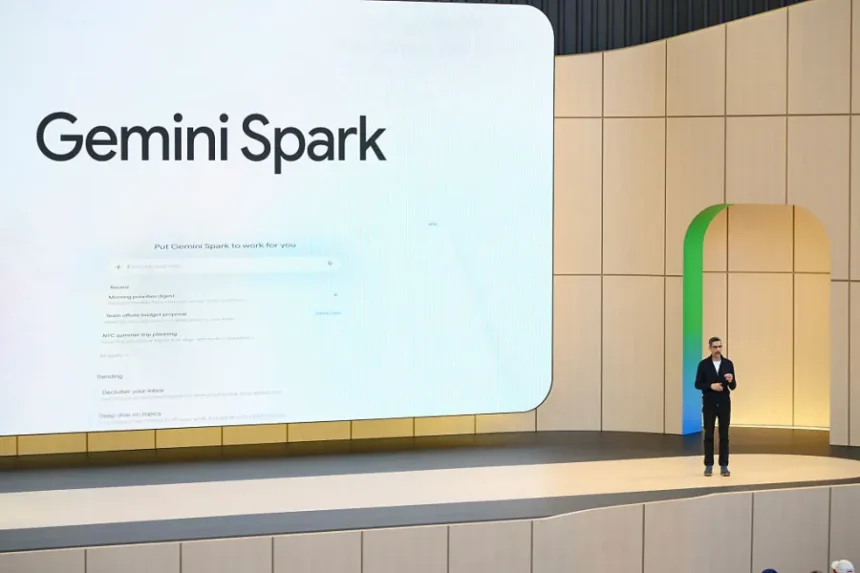
Google announced Gemini Spark at its annual developer conference in May, and the product that CEO Sundar Pichai joked would let users “close your laptop” is now in early access – a 24/7 agentic assistant that runs on virtual machines in the cloud, integrated with Gmail, Calendar, Docs, Sheets, and Slides, and designed to handle the kind of online to-dos that pile up because they involve too much manual screen time to bother with. The reference comparison Pichai chose was OpenClaw, an always-on AI system that requires keeping a machine awake to run. Spark, he argued, handles those tasks for ordinary users without the setup overhead. That positioning – agentic AI for the rest of us – is both the product’s strongest claim and the one that earns the most scrutiny, and it is the specific tension that NewsTrackerToday picked up as the evaluation frame for early access testing.
The use cases Spark handles credibly are real but narrow. Scanning emails and calendar for daily top priorities, compiling weekly newsletter summaries with links, finding local events across fragmented sources and aggregating them in one place, tracking deals in local retail apps with coupon stacking suggestions. Each of those tasks involves either accessing live data Spark can search or pulling information from Gmail and Calendar that Spark already reads. The coupon task produced a working result with one invalid promo code offset by other genuine savings. The newsletter summary returned four articles instead of the requested five. The event-finding task, perhaps the clearest success, found things a user would genuinely not have known to look for and offered to add them to the calendar with a single reply.
Sophie Leclerc, who covers the technology sector, reads the product architecture with some measured skepticism: “Spark is doing something genuinely interesting with the Gmail and Calendar integration, because those are data sources where context actually improves the output. You can have a useful interaction with your own inbox data in a way you can’t with generic search. But the gap I keep coming back to is that every test case that worked well was essentially a retrieval and summarization task. The cases that reveal the product’s limitations are the action-oriented ones: where Spark needs to interact with third-party apps it doesn’t yet support, like Google Keep, or where it needs MCP integrations that aren’t available yet. Those are not minor gaps for a product being marketed as a personal life organizer.”
The Keep integration omission is hard to explain on product terms. Google’s own note-taking app would be the natural landing spot for any list Spark generates: packing lists, to-do items, weekend plans. Instead, Spark offered to create a Google Doc or draft an email, which are functional but genuinely clunky for lightweight personal reference. The gap is what NewsTrackerToday ran through as the most useful proxy for where Spark actually sits on the maturity curve: a product that can articulate the use case for personal productivity correctly but has not yet built the integrations that would make it feel native to how people actually manage information outside of work.
Ethan Cole strips the business case down: “Google has Gemini. Now Google has Gemini Spark. These are the same infrastructure presented as two different products for two different occasions. That adds brand confusion in a market that already struggles to track which AI model does what. The question is whether the distinction converts casual Gemini users into Spark users who engage more deeply with Gmail and Calendar data, which would be a retention mechanism worth building. If it doesn’t do that, it’s an expensive toggle.” The toggle framing is literal: within the Gemini app, users switch to Spark mode rather than accessing it as a unified experience, which is the design decision that reviewers have most consistently questioned. That UI choice, and its implications for user adoption, is what NewsTrackerToday put in context alongside the underlying product quality.
Spark’s MCP integration roadmap will eventually add third-party app access: restaurant booking services, travel platforms, external calendars. Whether that pipeline arrives fast enough to matter, before Amazon, Apple, and Microsoft solidify their own always-on agentic assistants in adjacent ecosystems, is the question the early access period does not answer. And for iPhone users specifically, the inability to set Spark as a direct hardware button target – because the toggle sits inside the Gemini app rather than as a standalone service – limits the ambient accessibility that distinguishes useful AI tools from ones that require deliberate effort to remember. The product works. Whether it earns its separate name is the question that News Tracker Today flags for the next six months of iteration.