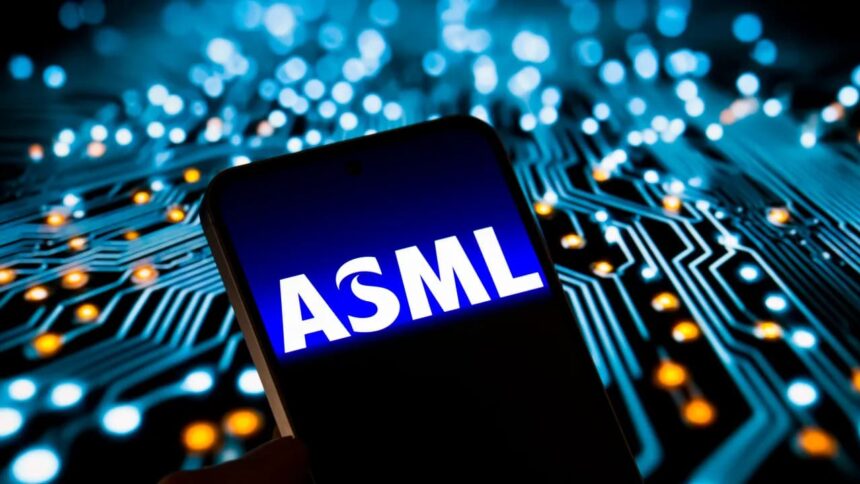
ASML, Europe’s most valuable listed company, is heading into its first-quarter earnings report with rising expectations that it may lift its financial outlook, as surging demand for artificial intelligence chips continues to drive orders for its equipment. Shares have climbed more than 40% this year, reflecting investor confidence that the company sits at the center of the AI supply chain, and as NewsTrackerToday tracks capital flows into critical infrastructure, ASML has become a focal point for exposure to the semiconductor boom.
The company’s dominance stems from its monopoly on extreme ultraviolet lithography systems – machines essential for producing the most advanced chips used by companies such as Nvidia and Apple. These tools represent the backbone of cutting-edge semiconductor manufacturing, positioning ASML not just as a supplier, but as a gatekeeper of technological progress. As chipmakers accelerate capacity expansion to meet AI-driven demand, orders for ASML’s systems have remained consistently strong.
This surge in demand is not without constraints. The production cycle for lithography machines can exceed a year, limiting the company’s ability to respond quickly to rising orders. At the same time, memory chip producers are scaling up aggressively, further intensifying pressure on supply chains. NewsTrackerToday highlights how this imbalance between demand and production capacity has shifted bargaining power toward equipment makers, allowing them to maintain pricing strength and visibility on future revenue.
Sophie Leclerc, who specializes in the technology sector, interprets ASML’s position as structurally advantaged within the AI ecosystem. Unlike chip designers or manufacturers that face competitive pressure, ASML operates in a near-monopolistic segment where technological barriers prevent rapid entry by rivals. This dynamic allows the company to capture value across multiple growth cycles, particularly as AI workloads drive sustained demand for advanced chips.
Investor optimism is also supported by expectations that ASML could revise its 2026 revenue guidance upward. Analysts anticipate that the company will land near the top end of its projected ranges, as customers rush to install previously ordered systems. NewsTrackerToday observes that the decision to stop reporting new bookings has shifted focus toward forward guidance, increasing the importance of management’s outlook as a signal for market direction.
However, geopolitical factors introduce uncertainty. Export restrictions to China remain a key risk, with the country previously accounting for a significant share of ASML’s revenue. New limitations proposed by U.S. policymakers could further reduce access to that market, forcing the company to rely more heavily on demand from other regions. While advanced EUV systems are already restricted, less advanced DUV equipment still represents a substantial portion of sales.
Liam Anderson, an expert in financial markets, notes that ASML’s valuation increasingly reflects its strategic role rather than just its earnings performance. Investors are effectively betting on the long-term expansion of the global semiconductor industry, with expectations that it could surpass $1 trillion in annual sales sooner than previously anticipated. In this context, ASML’s ability to scale production and manage geopolitical risks becomes critical to sustaining its growth trajectory.
The convergence of technological leadership, supply constraints, and geopolitical dynamics places ASML at the center of the AI-driven transformation of the semiconductor industry. As demand for advanced chips accelerates, the company’s performance will serve as a key indicator of how effectively the broader ecosystem can meet rising expectations. News Tracker Today frames this moment as a test of whether even the most strategically positioned supplier can keep pace with the unprecedented scale of the AI revolution.