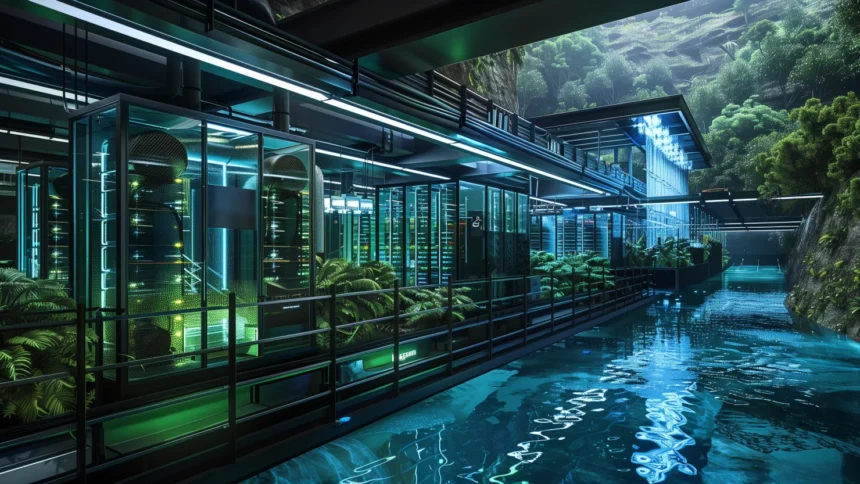
Artificial intelligence is advancing at a pace that is forcing governments, utilities, and technology companies to reconsider how energy-intensive data centers can coexist with environmental limits and strained power systems. As AI workloads expand, the infrastructure supporting them is becoming a strategic concern rather than a background technical issue – a shift that NewsTrackerToday has been tracking closely across technology and energy markets.
Data centers sit at the core of the digital economy, enabling nearly every online service. Yet they consume vast amounts of electricity and water, generate significant heat, and often face resistance from local communities. As more AI training and inference is concentrated in these facilities, pressure on grids and supply chains is intensifying, raising questions about whether current architectures can scale sustainably.
Executives across the sector increasingly acknowledge that incremental efficiency gains may no longer be enough. Simone Larsson, head of enterprise AI at Lenovo, recently warned that existing data-center designs are approaching a functional limit, as rising compute density collides with energy availability and regulatory constraints. The concern is not only technical but systemic, as power infrastructure struggles to keep pace with AI-driven demand.
Against this backdrop, technology firms and infrastructure developers are exploring unconventional design concepts. Research conducted by Lenovo in partnership with Opinium suggests that while most IT decision-makers prioritize energy efficiency, fewer than half believe their current data-center projects meet long-term sustainability goals. That gap is driving experimentation with underground facilities, modular “data villages” located near urban centers, and systems designed to reuse excess heat for residential or municipal purposes – themes that have increasingly featured in NewsTrackerToday’s coverage of digital infrastructure.
Some proposals push even further. Concepts such as heat-recycling data centers integrated into housing developments or wellness facilities aim to turn waste energy into a local asset. Others imagine distributed, modular campuses capable of adjusting capacity without massive new land use. Yet even their proponents concede that many of these designs remain decades away from commercial viability, constrained by cost, regulation, and the complexity of retrofitting existing grids.
The debate extends beyond Earth’s surface. Major technology groups and aerospace partners are investigating orbital data centers that could rely on constant solar exposure and eliminate land-use conflicts altogether. Pilot projects and feasibility studies suggest growing interest, but launch costs, radiation-resistant hardware, cooling challenges, and reliable high-speed connectivity remain formidable barriers. For now, space-based computing remains a long-term hedge rather than a near-term solution.
Sophie Leclerc, technology sector analyst at NewsTrackerToday, cautions that architectural innovation alone will not resolve the issue. “AI infrastructure is colliding with environmental and regulatory realities at the same time,” she said. “Without governance frameworks that align incentives – from grid investment to permitting – even the most advanced designs risk staying theoretical.”
Policy and economics ultimately determine what scales. Operators may adopt greener technologies voluntarily, but only if projects remain financially viable. Grid modernization, faster deployment of renewables, and clearer regulatory pathways are increasingly viewed as prerequisites rather than complements to AI growth. Ethan Cole, chief economic analyst at News Tracker Today, notes that the energy burden of AI is beginning to resemble a macroeconomic variable rather than an operational cost. “When compute demand starts to influence regional power pricing and investment cycles, infrastructure planning becomes an economic policy issue,” he said.
What emerges is a picture of an industry at an inflection point.
Data centers are no longer invisible warehouses of computation; they are becoming contested assets embedded in environmental, political, and economic systems. As NewsTrackerToday continues to monitor this transition, one conclusion is clear: sustaining the AI boom will require not just faster chips or clever designs, but coordinated shifts in policy, energy strategy, and public acceptance.