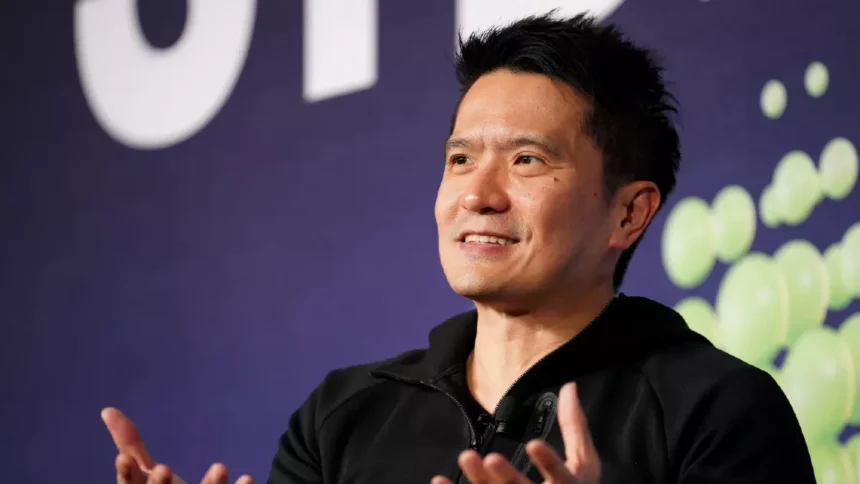
When an industry leader says artificial intelligence will “change everything” in gaming, it signals more than a technological shift. It marks the beginning of a new development cycle. Razer CEO and co-founder Min-Liang Tan has now made precisely that statement. Against the backdrop of a rapidly expanding global player base and a reshaping digital leisure economy, his words read not as prediction but as strategy. At NewsTrackerToday, we see Razer’s positioning as proof that AI is no longer an experimental add-on. It is evolving into foundational infrastructure for the gaming ecosystem.
The gaming audience today reaches around 3.6 billion people worldwide, with annual sector revenue approaching 189 billion dollars. At this scale, disruption is not optional – it is inevitable. Tan highlights that AI will reshape how developers build worlds, how publishers market releases and how players experience games. “This is not about adding new features, but about rebuilding the entire ecosystem,” we note at NewsTrackerToday, interpreting this as a blueprint for a new competitive model.
Razer is already rolling out its first steps. Game Co-AI uses computer vision to analyze gameplay in real time, offering tactical suggestions and lowering entry barriers for complex mechanics. The company plans to release a public beta in late 2025. Parallel to this, Razer is developing an AI QA Companion designed to automate significant portions of the testing pipeline. Today, quality assurance consumes roughly 20–30 percent of development budgets and timelines, according to Tan. Razer’s new AI module can monitor bugs, structure reports and eventually propose fixes. In effect, the company is shifting key cycles of game development into the era of AI-driven operations.
The economic implications are clear. As Ethan Cole, chief macro analyst at NewsTrackerToday, emphasizes: “When a platform serving billions begins automating its core workflows, it becomes a macro-trend – comparable to the rise of mobile ecosystems or the cloud revolution.” From our perspective, the future of gaming will be defined by three dimensions: development cost efficiency, depth of player engagement and scalability of content pipelines.
At the same time, disruption brings tension. In esports, teams are already exploring the idea of AI coaching systems. But concerns are rising: where does training end and unfair advantage begin? Even Tan admits that while AI likely won’t operate during official matches, practice environments “will never be the same again.” Meanwhile, conservative voices remain. Take-Two CEO Strauss Zelnick argues AI still cannot match human creativity in crafting iconic worlds – though he concedes that one or two AI-built titles could succeed in the near future.
From a technology standpoint, the opportunity horizon is vast. Sophie Leclerc, technology analyst at NewsTrackerToday, observes: “AI personalizes gameplay while industrializing development. What once required hundreds of people can now be augmented and verified by models.” We interpret this as the emergence of a hybrid creative model – humans shaping vision and worlds, while AI accelerates iteration and supports mechanics.
Signs of this shift are already visible. Studios are training AI-powered NPCs, platforms are building recommendation engines for in-game economies, and players are gaining access to skill-enhancing assistants. We believe that between 2025 and 2027, success will hinge on each company’s ability to integrate AI across the full game lifecycle – from content creation and QA to retention systems and gameplay analytics.
The strategic recommendations follow naturally. Developers should invest in AI assistants and automated QA infrastructure. Publishers must prioritize flexible, AI-driven marketing and audience segmentation. Esports organizations need ethical frameworks around AI-based training tools and should adopt analytics for performance development. Investors should focus on companies building scalable AI stacks rather than one-off tools.
Gaming has always been a proving ground for technology, but now it becomes a testing field for a new digital economy. AI will not replace human creativity – it will reorganize its workflow and velocity. And those who treat this shift not as a threat but as an opening will shape not only games, but the future of the entire industry – a trajectory we at News Tracker Today consider inevitable.