The theatrical exhibition industry is no longer moving as a single market, and in 2025 that divergence has become unmistakable. From our perspective at NewsTrackerToday, IMAX has emerged as the clearest financial and strategic outlier in a sector still struggling to define its post-pandemic equilibrium.
IMAX shares surged more than 44% in 2025, outperforming not only its direct peers but most media and entertainment stocks, even before the company reported a record $1.28 billion in global box office revenue for the year. That figure represented more than 40% growth compared with 2024 and exceeded the previous all-time high set in 2019. At the same time, traditional theater operators moved in the opposite direction. AMC’s stock collapsed by over 60%, Cinemark fell roughly 25%, and Marcus Corp. declined close to 30%, underscoring how unevenly the industry’s recovery has played out.
This divergence reflects more than temporary sentiment. While U.S. box office receipts have rebounded from pandemic-era lows, they remain structurally below pre-2019 levels, with domestic ticket sales still roughly a quarter beneath their historical peak. Analysts increasingly view this not as a cyclical delay but as a permanent reset in consumer behavior, driven by streaming competition, cost-of-living pressures, and a thinner theatrical release slate.
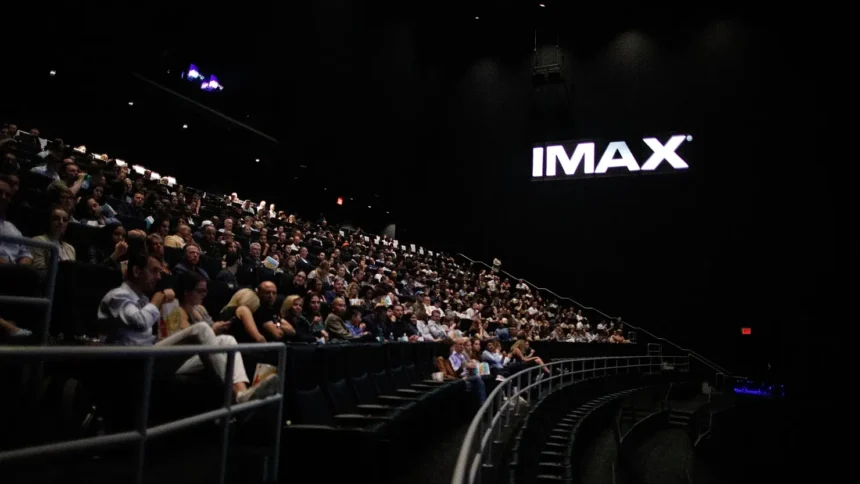
At NewsTrackerToday, we interpret IMAX’s resilience as evidence that theatrical demand has not disappeared, but concentrated. When consumers do choose to leave home, they are increasingly willing to pay for premium large-format experiences. In 2025, premium formats accounted for more than 16% of domestic ticket sales, continuing a steady multi-year rise. Average PLF ticket prices widened the gap versus standard admissions, reinforcing pricing power precisely where volume is most constrained.
Liam Anderson, NewsTrackerToday’s financial markets analyst, views this shift as structural rather than cyclical. In his assessment, IMAX functions less like a traditional exhibitor and more like an infrastructure layer that monetizes blockbuster demand without absorbing the full fixed-cost burden of operating theaters. That distinction matters as film output remains uneven and capital discipline tightens across Hollywood.
The company’s asset-light model has become a central differentiator. Instead of owning real estate, IMAX licenses proprietary technology and shares in box office revenue with theater partners. This allows it to scale profitably even as overall attendance remains volatile. By contrast, theater chains must carry rent, labor, and utility costs regardless of foot traffic, relying heavily on concessions to offset declining ticket margins.
That difference showed up clearly in profitability. While AMC, Cinemark, and Marcus all posted losses during parts of 2025, IMAX remained profitable across each reported quarter, with net income rising sharply year over year. Its screens still represent less than 1% of global theater capacity, yet command disproportionate box office share for major releases, especially large-scale franchises and director-driven tentpoles filmed specifically for IMAX presentation. Isabella Moretti, who covers corporate strategy and media economics for NewsTrackerToday, notes that studios are increasingly designing release strategies around premium formats. In her view, the value is no longer in maximizing screen count but in maximizing experiential differentiation, giving IMAX leverage well beyond its physical footprint.
Looking toward 2026, the implications are increasingly difficult to ignore. IMAX projects another record year in global box office, supported by a slate dominated by franchise sequels and visually intensive films engineered for premium exhibition. Meanwhile, traditional exhibitors face a narrower margin for error, with renovation costs, debt loads, and inconsistent content supply limiting flexibility.
The outcome is not the collapse of theaters, but a two-speed industry. Premium formats continue to consolidate value, while standard exhibition remains under pressure. For investors, IMAX represents exposure to the highest-value segment of theatrical demand rather than a broad recovery bet. For operators, the message is equally clear: differentiation, not scale, now determines survival. At News Tracker Today, we see IMAX’s performance not as an anomaly, but as a signal. The future of theatrical cinema will not be decided by how many screens exist, but by how compelling those screens are when audiences decide the experience is worth the trip.