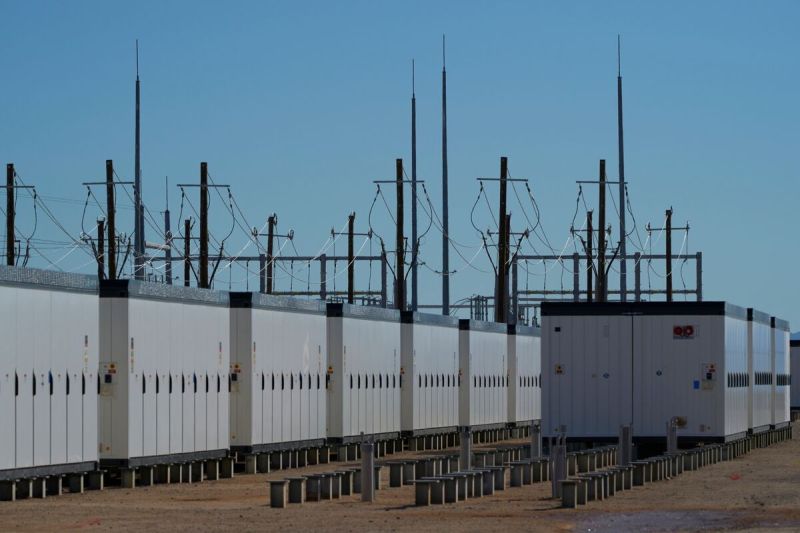
U.S. automakers and battery producers are accelerating a strategic pivot toward energy storage, seeking new growth avenues as electric vehicle markets mature and infrastructure demand surges. The shift reflects both opportunity and constraint, as companies attempt to localize supply chains while responding to rising demand from data centers and grid operators, and as NewsTrackerToday tracks industrial realignment in energy systems, battery storage is emerging as a central battleground.
A key challenge lies in reducing dependence on China, which dominates the production of lithium iron phosphate (LFP) batteries and critical materials. U.S. producers must gradually eliminate Chinese content to qualify for federal tax incentives tied to domestic manufacturing, adding complexity to an already capital-intensive transition. At the same time, tariffs on Chinese cathode and anode materials – now at 35% – further increase costs, forcing companies to rethink sourcing strategies and accelerate local production capacity.
Despite these hurdles, momentum is building. General Motors and its joint venture partner LG Energy Solution recently committed additional investment to convert part of their manufacturing capacity toward battery cells for energy storage. Ford has taken a similar approach, repurposing underutilized facilities to support storage production. NewsTrackerToday highlights how this repurposing strategy allows legacy automakers to adapt existing infrastructure rather than build entirely new plants, improving capital efficiency.
Daniel Wu, who specializes in geopolitics and energy, interprets the trend as part of a broader decoupling process in global supply chains. As geopolitical tensions reshape trade relationships, energy storage becomes not only a commercial opportunity but also a strategic priority. Domestic production of batteries supports grid resilience and reduces exposure to external supply disruptions, particularly in critical technologies tied to energy security.
Tesla remains a dominant force in this segment, having spent years developing its energy storage business. Its Megapack systems have seen rapid deployment, driven in part by demand from AI-focused data centers requiring stable and scalable power solutions. Notably, Tesla’s storage division has achieved higher margins than its automotive business, underscoring the economic attractiveness of this market. NewsTrackerToday notes that profitability in storage – combined with growing demand – is encouraging traditional automakers to accelerate their entry into the space.
Liam Anderson, an expert in financial markets, points out that the economics of energy storage are increasingly compelling relative to electric vehicles. While EV margins remain under pressure due to competition and pricing dynamics, storage systems benefit from long-term contracts and predictable demand from utilities and large-scale industrial clients. This shift may influence how investors evaluate automotive companies transitioning into broader energy platforms.
The intersection of policy, technology, and market demand is driving a rapid transformation of the battery industry. Companies that can secure supply chains, optimize production, and scale storage solutions stand to gain a competitive edge in a sector that extends beyond transportation into energy infrastructure. The growing focus on storage signals a redefinition of what it means to be an automotive company, as manufacturers expand into adjacent energy markets. News Tracker Today sees this transition as a pivotal shift, where batteries evolve from a component of vehicles into a cornerstone of the global energy ecosystem.