At NewsTrackerToday, we see the start of November not just as a calendar milestone, but as the opening of a market phase shaped by three forces: accelerating AI investment, macro-policy signals, and remarkably resilient corporate earnings. October closed strong, with the S&P 500 up 2.3%, the Dow rising 2.5%, and the Nasdaq gaining nearly 5%. Historically, November has been the strongest month for the S&P – and futures are green – yet sentiment remains delicate as investors weigh corporate guidance against looming Supreme Court hearings on U.S. trade policy.
Earnings momentum remains a defining narrative. More than 300 S&P 500 companies have reported results, and over 80% have beaten estimates. Confidence is firm, but markets are demanding clear forward guidance, especially in AI-linked sectors where capital expenditures are soaring. This week will bring results from Palantir, Uber, AMD and McDonald’s, giving investors another read on enterprise demand, consumer resilience and tech spending. As NewsTrackerToday chief economist Ethan Cole notes, “The AI trade has shifted from surprise to expectation. From here, performance depends on execution, not optimism.”
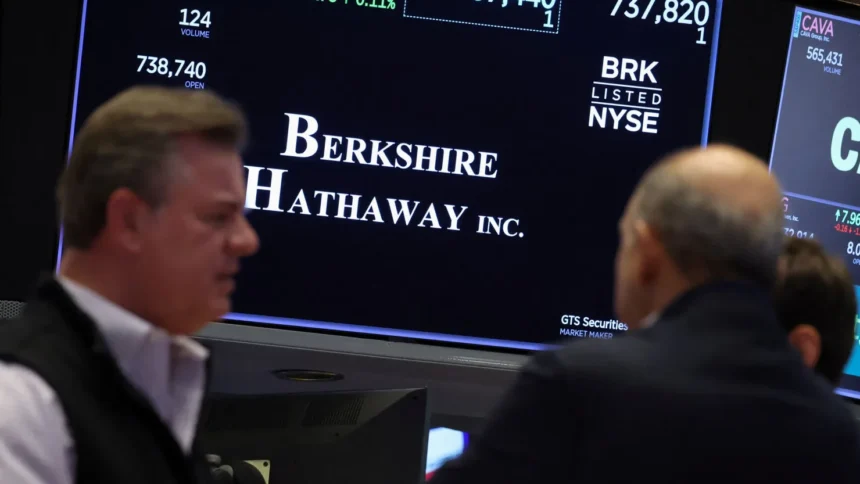
On the macro front, Berkshire Hathaway delivered one of the most symbolic datapoints of the quarter: a record cash pile nearing $382 billion. Warren Buffett refrained from buybacks, despite a pullback in Berkshire’s shares earlier this year. To us, that restraint serves as both a caution signal and a liquidity strategy – a message that valuations remain elevated and patience is still a competitive advantage. It also suggests Berkshire is positioning for dislocation or opportunity, whichever comes first.
Big Tech continues to anchor market psychology. Meta, Amazon, Alphabet and Microsoft all reported robust digital advertising trends while maintaining extraordinary capital commitments to artificial intelligence. With combined capex expected to exceed $380 billion this year, the AI build-out is now industrial policy by another name. “This is not speculation – it is the construction phase of the AI economy,” observes NewsTrackerToday technology analyst Sophie Leclerc. For investors, that scale is both bullish and demanding: infrastructure spending must translate into productivity and revenue gains.
In Washington, a federal court decision requiring the government to use emergency funds to continue SNAP food benefits has eased fears around consumer fragility at the lower end of the income spectrum. With 42 million Americans relying on the program, the ruling removes an immediate source of downside risk for discount retailers, grocers and credit-exposed consumer lenders. In a cycle defined by inflation and policy unpredictability, social-support continuity matters for demand stability.
Meanwhile, the pharmaceutical battlefield intensifies. Eli Lilly and Novo Nordisk remain dominant in the GLP-1 obesity and diabetes segment, but investor focus is shifting to supply scaling, long-term safety data and the emerging wave of lower-cost competitors. The addressable market could exceed $100 billion by 2030, making delivery efficiency, innovation pace and regulatory management decisive factors for leadership. As access issues push some patients toward cheaper alternatives, the next phase of this story will test pricing power and durability of first-mover advantage.
At NewsTrackerToday, we enter November with constructive caution. Earnings strength, AI investment and policy clarity support the bull case, but expectations are high and concentration risk remains real.
Our guidance for investors:
- Avoid over-weighting mega-cap AI winners – pair them with quality mid-caps in adjacent value chains
- Track capex commentary closely; it is the best real-time gauge of AI-cycle conviction
- Treat GLP-1 exposure as a portfolio theme rather than a single-stock bet
- Monitor U.S. social-policy developments as a proxy for low-income demand resilience
We at News Tracker Today believe November rewards discipline over enthusiasm. When narratives are priced in, the edge shifts to those who stay grounded in data, capital efficiency and execution quality. In a market that loves stories, mathematics – once again – decides the winners.