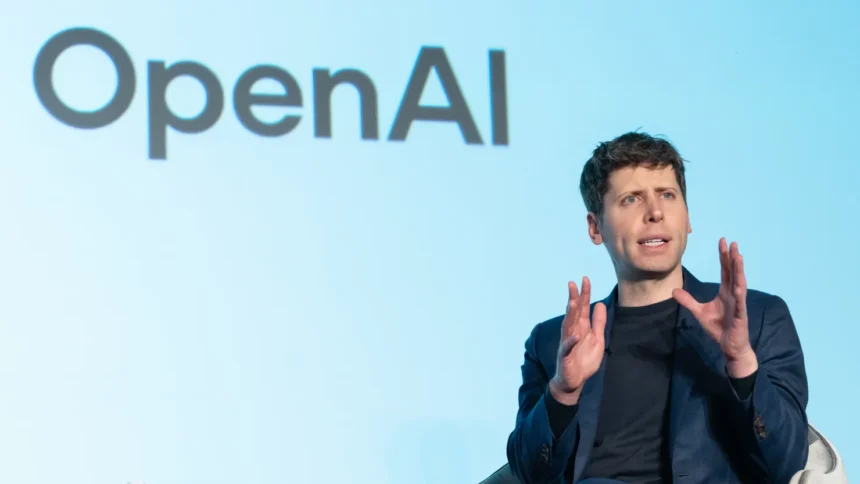
When OpenAI launched in December 2015, it positioned itself as a counterweight to commercial AI development. Backed by a $1 billion pledge from Elon Musk and prominent Silicon Valley figures, the lab was meant to pursue artificial intelligence free from market pressure and profit incentives. NewsTrackerToday notes that the original vision was deliberately idealistic: AI developed slowly, openly and “for the benefit of humanity.”
A decade later, that founding principle has been almost entirely eclipsed by scale, capital and competition.
OpenAI has transformed into one of the fastest-growing commercial technology companies in history, reaching an estimated valuation of roughly $500 billion – almost all of it generated since the launch of ChatGPT three years ago. The product now serves more than 800 million weekly users, placing OpenAI at the center of the global AI economy. At the same time, Musk, now the world’s richest individual, has exited the organization and built a rival, xAI, while engaging in an increasingly public legal and reputational conflict with OpenAI CEO Sam Altman.
According to people familiar with recent fundraising activity, Musk’s xAI is expected to close a $15 billion round this month at a valuation near $230 billion. Together with OpenAI, Google, Anthropic and Meta, these companies are driving an unprecedented wave of investment as the AI market rapidly shifts from text-based chatbots toward video generation, agentic systems and enterprise-grade productivity tools.
From NewsTrackerToday’s assessment, OpenAI’s current strategy rests on an extraordinary financial gamble. The company’s long-term infrastructure ambitions – spanning hyperscale data centers, custom silicon and global compute capacity – imply capital commitments that could exceed $1 trillion over time. That level of spending places OpenAI in direct competition not only with AI peers, but with the largest technology platforms and their chip suppliers.
Liam Anderson, NewsTrackerToday analyst focused on financial markets, sees parallels with earlier tech cycles. “OpenAI has become a capital-intensive growth machine,” he explains. “The question for investors is whether this is closer to a Google-style platform moment – or a Netscape-style inflection that ultimately benefits someone else.”
The contrast with OpenAI’s early years is stark. In 2016, Nvidia CEO Jensen Huang personally delivered a DGX-1 supercomputer to OpenAI’s San Francisco office – a $300,000 machine developed at enormous internal cost with no other buyers at the time. Musk was the only customer willing to take it, despite OpenAI’s non-profit status. Even then, the economic tension was visible beneath the surface.
Internal correspondence from that period shows Musk expressing frustration with OpenAI’s trajectory, warning in 2017 that he would withdraw funding if the organization moved toward a startup-style model. Altman publicly reaffirmed commitment to the non-profit structure, but by early 2018 Musk left the board, citing conflicts of interest as Tesla deepened its own AI work.
That split has since evolved into open confrontation. In 2024, Musk sued OpenAI and Altman, accusing them of abandoning the lab’s original mission and aligning too closely with Microsoft. He has sought to block OpenAI’s restructuring and even attempted to acquire the organization outright for nearly $100 billion. OpenAI responded by formalizing a hybrid structure, retaining non-profit control while operating its commercial arm as a public benefit corporation under OpenAI Group PBC.
The rift extends beyond Musk. Former OpenAI researchers Dario and Daniela Amodei left in 2020 to found Anthropic, now one of OpenAI’s most formidable competitors. Backed by Microsoft and Nvidia, Anthropic’s valuation is reported to be approaching $350 billion, with its Claude models directly challenging OpenAI’s GPT family.
Yet the strategic divergence is clear. Anthropic’s infrastructure commitments are estimated around $100 billion over several years, while OpenAI’s plans dwarf that figure. Ethan Cole, NewsTrackerToday’s chief economic analyst, describes the gap as material. “Anthropic is scaling within visible financial constraints,” he says. “OpenAI is betting that demand growth will justify spending levels that would be considered extreme in almost any other sector.”
That bet depends on AI demand continuing to accelerate. Altman has argued publicly that internal usage data supports aggressive expansion, forecasting annual revenue of $20 billion by year-end and potentially hundreds of billions by 2030. Major partners and suppliers have already embedded OpenAI-related demand into long-term projections, including multiyear infrastructure agreements worth hundreds of billions of dollars.
Still, market signals are mixed. Recent earnings volatility among AI-linked infrastructure providers has exposed investor anxiety around leverage and capital intensity. Even as backlog commitments grow, equity markets have shown less tolerance for balance-sheet risk, particularly where long-term contracts are paired with rising debt.
Venture investors, however, remain divided. Some argue the convergence of models, chips and hyperscale compute could unlock trillions in economic value, justifying today’s valuations. Others worry that the industry is building capacity faster than monetization can follow.
Inside OpenAI, the pressure is evident. Altman has declared an internal “red alert,” reallocating resources toward improving the speed, reliability and personalization of ChatGPT while delaying work on adjacent agent products. The move follows renewed competitive pressure after Google’s latest model releases and underscores how quickly leadership positions can shift.
As News Tracker Today sees it, OpenAI’s story is no longer about ideals versus commercialization. It is about whether unprecedented capital deployment can be converted into durable market dominance. The company helped ignite the AI revolution – but history suggests that shaping a revolution does not always guarantee ownership of its final outcome.