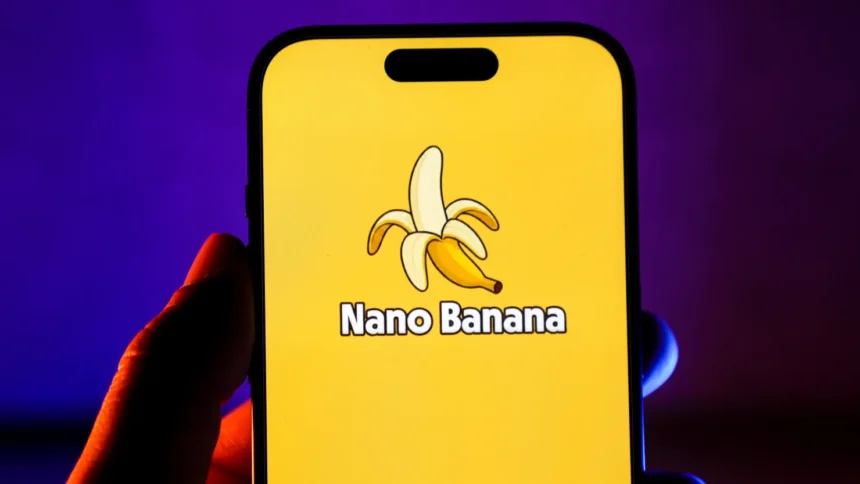
Google has introduced Nano Banana 2, the latest iteration of its fast-growing AI image generator, signaling an intensified phase in the battle for visual AI dominance. What began as a viral consumer tool is now evolving into infrastructure for commercial content production. As YourNewsClub observes, the competition is no longer limited to image quality – it now centers on speed, instruction precision, contextual intelligence, and ecosystem integration.
Nano Banana 2 integrates more deeply with Gemini, allowing the model to leverage broader world knowledge and real-time contextual signals. Google emphasizes improved prompt adherence, faster generation speeds, and notably enhanced text rendering within images – an area where many AI generators have historically struggled. Jessica Larn, who analyzes technology infrastructure consolidation, argues that coupling large language models with visual engines represents a structural advantage. In her view, contextual understanding derived from language models enables higher-fidelity interpretation of complex instructions, especially in commercial applications such as branded marketing assets.
Google has retained Nano Banana Pro for high-precision workflows, while positioning Nano Banana 2 as a speed-oriented, instruction-focused tool for rapid creation. This dual-tier approach reflects a broader segmentation strategy. YourNewsClub notes that enterprise-grade accuracy and mass-market accessibility now coexist within a single platform ecosystem. By differentiating performance tiers, Google aligns with both professional creative studios and everyday content creators.
The competitive landscape continues to intensify. OpenAI advances its video generation capabilities, Adobe deepens AI integration within Firefly, and ByteDance invests in generative video systems. The surge in demand has also placed pressure on compute infrastructure, highlighting scalability as a decisive factor. Alex Reinhardt, specializing in platform economics and digital monetization structures, suggests that operational resilience may prove as important as generative quality. He emphasizes that consistent performance under heavy usage conditions determines enterprise adoption more than viral consumer appeal.
Copyright concerns further complicate the landscape. Creative industries have raised alarms regarding dataset transparency and derivative content risks. Regulatory scrutiny is expected to expand, particularly around training data provenance and content attribution frameworks. YourNewsClub assesses that companies proactively implementing licensing safeguards and audit transparency mechanisms will gain long-term strategic credibility.
Beyond feature improvements, Nano Banana 2 strengthens Google’s Gemini-centered ecosystem strategy. By embedding image generation within a broader multimodal architecture that spans text, search, and visual creation, Google increases platform stickiness. Your News Club highlights that ecosystem integration may ultimately outweigh standalone product excellence. The more seamlessly visual generation integrates with search queries, document workflows, and productivity tools, the greater the lock-in effect.
Over the next 12 to 18 months, three structural developments appear likely. First, generative visual tools will embed deeper into corporate workflows, transitioning from novelty to operational necessity. Second, infrastructure competition will intensify as providers race to optimize compute efficiency and latency. Third, regulatory adaptation will reshape compliance standards around intellectual property and data transparency.
Nano Banana 2 therefore represents more than a feature update. YourNewsClub views it as a strategic move within a broader contest to define the foundational layer of digital creativity. The companies that successfully combine contextual intelligence, scalable infrastructure, and regulatory foresight will shape the next chapter of the AI-driven content economy.