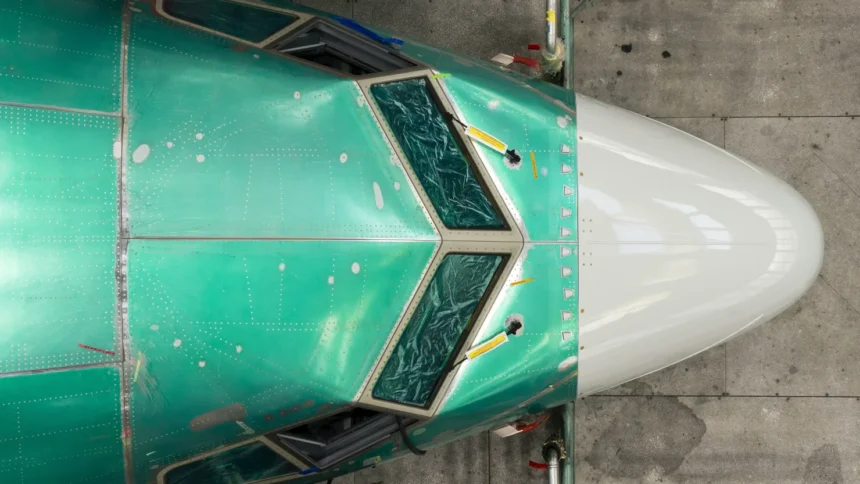
Boeing is preparing to report its strongest aircraft delivery performance since 2018, a milestone that signals more than a numerical rebound. For NewsTrackerToday, the significance lies in the company’s transition away from crisis containment toward operational predictability after years defined by safety failures, production halts and regulatory scrutiny.
Following the 737 MAX crashes, pandemic disruptions and the 2024 mid-air door plug incident, Boeing spent much of the past seven years managing reputational damage and stabilizing its manufacturing base. That phase now appears to be ending. With deliveries accelerating and regulatory oversight gradually easing, the company is positioning itself to increase output of its most profitable programs, including the 737 MAX and 787 Dreamliner.
From the perspective of NewsTrackerToday, delivery consistency is the critical metric. Aircraft manufacturers generate the bulk of their cash upon delivery, meaning even modest improvements in production cadence can materially affect liquidity and profitability. Boeing’s ability to deliver more than 530 aircraft across the first eleven months of the year marks a return to industrial rhythm, even if volumes remain below the 2018 peak.
Liam Anderson, financial markets analyst, views the recovery as fundamentally cash-driven rather than reputational. In his assessment, Boeing’s reduced reliance on rework-heavy “traveled work” lowers hidden costs and stabilizes working capital. According to Anderson, investors are not demanding flawless execution – they are watching for repeatability. Each incremental production increase compounds cash flow benefits across Boeing’s commercial segment.
Operational reforms under new leadership have focused on stricter assembly sequencing, workforce retraining and tighter quality controls. The reintegration of fuselage supplier Spirit AeroSystems further reflects Boeing’s intent to reduce fragmentation across its supply chain. NewsTrackerToday interprets this move as an effort to shorten defect feedback loops, though it also concentrates execution risk back inside Boeing’s own operations.
Certification delays remain the principal constraint on faster expansion. The MAX 7, MAX 10 and 777X programs continue to limit delivery potential and defer revenue. Yet airline demand has not softened. Order books extend well into the 2030s, and recent commitments from major carriers underscore confidence that certification will eventually follow production readiness.
Daniel Wu, geopolitical and industrial policy analyst, frames Boeing’s next phase as a test of institutional trust. In his view, regulators and global airline customers are no longer swayed by strategic importance alone. Rising output will only be tolerated if matched by verifiable quality improvements. Wu notes that Boeing’s recovery is unfolding under tighter global scrutiny than at any previous point in its history.
For News Tracker Today, the outlook into 2026 is cautiously constructive. Boeing is likely to favor controlled production increases over aggressive volume targets, prioritizing reliability over speed. If execution holds, the company has a credible path back to sustained profitability. If it falters, tolerance from regulators and customers may evaporate quickly.
The recovery is real – but it is no longer about promises. As NewsTrackerToday sees it, Boeing’s future will be decided on factory floors, certification timelines and delivery schedules, not press statements.