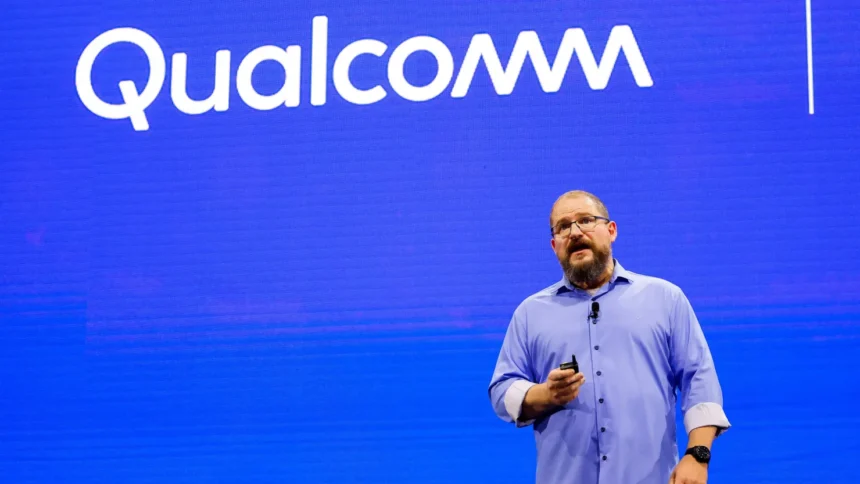
Qualcomm is signaling that its next meaningful growth engine may sit outside smartphones. Speaking at Mobile World Congress in Barcelona, CEO Cristiano Amon said robotics could become a materially larger opportunity within roughly two years. As NewsTrackerToday sees it, that statement places Qualcomm directly inside the accelerating shift from digital AI to what the industry increasingly calls “physical AI.”
In January, the company introduced its Dragonwing-branded robotics processor, designed as a scalable chipset platform rather than a niche component. The strategy mirrors Qualcomm’s Snapdragon playbook in mobile: create a flexible compute architecture that manufacturers can deploy across multiple device categories. NewsTrackerToday notes that success in robotics will depend less on peak benchmark performance and more on efficiency, integration simplicity, and software ecosystem maturity.
The robotics landscape spans industrial robotic arms, warehouse automation systems, autonomous mobile robots, and emerging humanoid platforms. Market forecasts vary widely, with long-term projections ranging into the hundreds of billions or even trillions of dollars. Yet projections alone do not create revenue. Sophie Leclerc, technology sector analyst, argues that “real-time edge computing with low power consumption will define which chip vendors succeed in robotics.” She emphasizes that robots operating in physical environments require stable latency, secure connectivity, and resilient thermal performance – characteristics where Qualcomm historically demonstrates strength.
The optimism around robotics increasingly ties to advances in AI models capable of perception, navigation, and contextual reasoning. Amon framed robotics growth as a function of these improvements, suggesting that enhanced models now allow machines to operate more autonomously. NewsTrackerToday highlights that this transition from automation to autonomy changes the value proposition for chipmakers: processing must move closer to the edge to support real-time decision-making without constant cloud dependence.
Competition remains intense. Nvidia has repeatedly identified robotics as a major long-term growth pillar, while numerous startups and established players are developing specialized silicon. Isabella Moretti, corporate strategy analyst, explains that “platform control will matter more than raw chip capability. The vendor that secures long-term OEM partnerships and integrated developer tooling will capture disproportionate value.” Qualcomm therefore must position Dragonwing not merely as hardware, but as a full-stack development ecosystem.
In the near term, investors will look for tangible indicators: commercial design wins, recurring contracts, and cross-segment adoption beyond pilot projects. Industrial robotics may scale first due to clearer ROI metrics, while humanoid systems remain further from mass deployment. News Tracker Today assesses that Qualcomm’s opportunity lies in leveraging its experience in power-efficient system-on-chip design and adapting it to robotics environments where reliability and uptime dictate purchasing decisions.
Ultimately, robotics represents both a diversification strategy and a competitive necessity. Smartphone markets have matured, and semiconductor companies increasingly seek adjacent growth domains. If Qualcomm converts Dragonwing into a trusted robotics platform, it can extend its core competence in edge computing into a new cycle of device proliferation. If adoption remains fragmented or ecosystem development stalls, robotics may remain an aspirational narrative rather than a substantial revenue contributor. As NewsTrackerToday continues to track semiconductor expansion into physical AI, Qualcomm’s two-year horizon will serve as a meaningful test of execution.