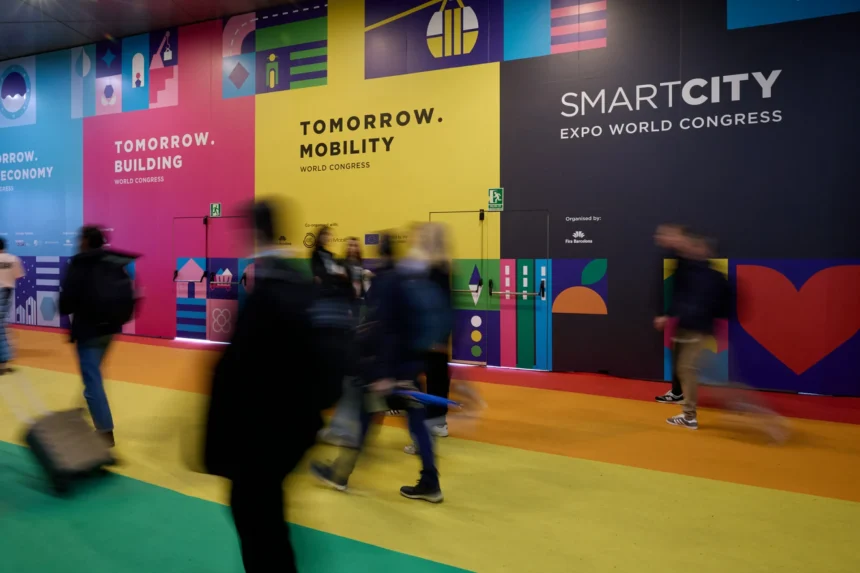
Barcelona’s Smart City Expo World Congress this year felt less like a futuristic spectacle and more like a quiet architectural shift in how cities understand themselves. The atmosphere did not evoke flying pods and cloud-high towers from “The Jetsons” but something far more grounded: a sense that the machinery of cities is finally being rewired from the inside. At NewsTrackerToday, we see this transition as a turning point; urban leaders are no longer fantasizing about tomorrow but actively assembling it from software, data and infrastructure.
Orbit City once floated above the clouds. Today’s cities build digital twins and AI-driven models capable of reading street grids, predicting energy patterns and analyzing infrastructure in real time. This version of the future does not glitter; it functions. Companies showcased systems that accelerate licensing, automate paperwork and break through bureaucratic bottlenecks that have slowed construction for decades. This shift is significant. Automation is not here to decorate cities but to increase their throughput.
Speakers emphasized a familiar but crucial fact. Cities now generate roughly 80 percent of global GDP, consume about two thirds of the world’s energy and house more than half the global population. That means when climate systems crack or infrastructure fails, cities are the first to feel it. Corporate strategy analyst Isabella Moretti noted that cities are becoming “competitive economic actors,” where the winners are those that adapt fastest to climate pressure, demographic change and resource constraints. Her observation aligns with our perspective at NewsTrackerToday: running a city increasingly resembles managing a continuously evolving data platform.
The Expo’s center of gravity was not speculative tech but practical examples. US mayors spoke not about drones or holograms but about business licenses, multilingual council meetings and the urgent need to automate routine city work. In Montgomery, AI is already speeding up small-business licensing, preventing delays that once swallowed weeks. In Tampa, AI layered over camera networks identifies anomalies in nightlife districts, reducing pressure on police. Yet every new layer of data revives the same concern: residents worry their city is watching more closely than they ever asked.
Meanwhile, AI-powered traffic systems are reducing idling at intersections and cutting emissions. Emergency dispatch centers in San Jose and Columbus now translate 911 calls into dozens of languages, expanding access for residents long excluded by language barriers. Amarillo’s AI assistant Emma has replaced a maze of PDFs with conversational access to city services, a shift that NewsTrackerToday has repeatedly highlighted as one of the clearest examples of practical civic innovation. None of this resembles science fiction, yet each example represents a deeply practical improvement.
Across the Expo, digital twins emerged as the backbone of next-generation planning. South Korea has been building full-district twins for years, while Finland’s city of Tampere has stitched together traffic, lighting, maintenance, telecom security and heating into a unified data layer used for both live operations and experimentation. Energy and geopolitics analyst Daniel Wu underscored the stakes. “Cities that can forecast and stabilize energy loads will have a real advantage as the global energy transition accelerates,” he said.
Rome was crowned the world’s “smartest city” this year not for a single megaproject but for its integrated strategy “Rome, the Transforming City.” Its real-time operations center pulls in transit, tourism and infrastructure data to manage peaks, including this summer’s surge of over one million visitors. The star of the strategy is Rome’s digital twin, a living 3D model that lets planners test scenarios before changing a single street in the real world.
By the time the Expo lights dimmed, one conclusion was clear. The future of cities will not look like flying capsules or holographic skylines. It will look like fewer Friday traffic jams, buses that arrive when the app says they will, streetlights that warn of outages before they fail and permits issued in days instead of months. At News Tracker Today, we believe city leaders must begin treating urban systems as software: modular, upgradeable and ready to scale.
Our recommendation is straightforward. Cities should start by deploying AI where the impact is immediate: traffic, licensing, emergency services. Next, build integrated data platforms and partner with organizations capable of creating digital twins and infrastructure models. The smart city is no longer a futuristic fantasy. It is an engineering project whose success depends not on spectacle but on execution.