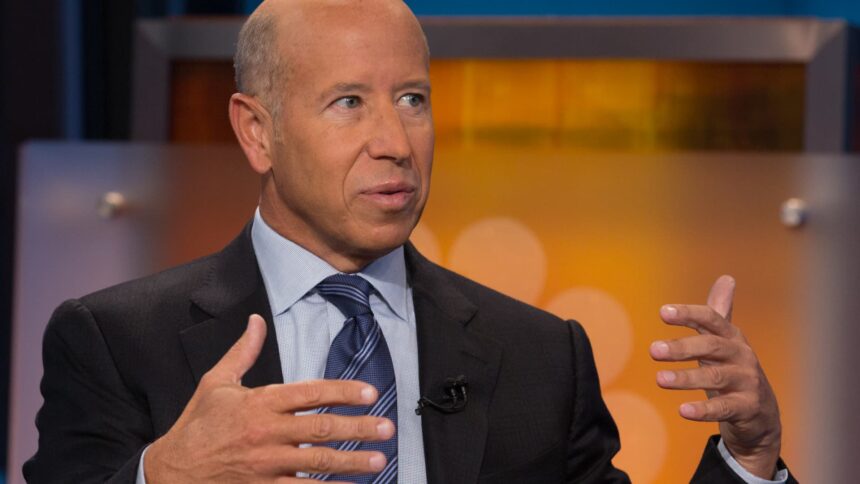
Billionaire Barry Sternlicht, chairman and CEO of Starwood Capital Group, and Brendan Wallace, co-founder of Fifth Wall, might have met in a gym, but their partnership has since evolved into something far more strategic – a bridge between traditional real estate and the digital economy. At NewsTrackerToday, we see their collaboration as a reflection of a broader market shift, where physical assets and digital infrastructure are beginning to merge into a single investment frontier. One is a veteran investor who built his fortune on physical assets; the other represents a new generation of entrepreneurs turning data, carbon efficiency, and artificial intelligence into real capital. Together, they’re redefining what property means in the 21st century.
This intersection represents more than just a business trend – it marks a turning point where financial infrastructure meets technological infrastructure, and the future of investment begins to look less like concrete and more like computation.
Sternlicht recalls that investors have just endured one of the fastest rate-hike cycles in decades – a 500-basis-point surge that hit nearly every corner of commercial real estate. Rising borrowing costs, he says, wiped out liquidity and forced many firms to reassess their portfolios. Yet he’s confident the tightening cycle is nearing its end. He expects the Federal Reserve to begin cutting rates in the coming year, arguing that most inflationary pressures are trade-related rather than structural.
Wallace agrees but points to a different battlefield – PropTech. “The rate hikes punished technology-driven and loss-making companies the hardest,” he explains, noting that much of the recent investment in real estate has shifted toward decarbonization and compliance with net-zero regulations. At NewsTrackerToday, we view this as part of a structural transformation of the property market, where sustainability is no longer a branding exercise but a financial imperative. He believes the trend toward sustainability is irreversible, even if political shifts in the U.S. temporarily slow the pace.
According to Isabella Moretti, corporate strategy and M&A analyst, this fusion of property and technology marks “a structural transformation of the asset market.” She observes that “every square meter must now function as part of a digital ecosystem. Traditional rent and ownership models are giving way to infrastructure partnerships with technology corporations.”
Sternlicht, for his part, is heavily betting on data centers, revealing that his firm has committed around $20 billion to the sector. Such facilities, he explains, are typically built only under long-term leasing contracts with hyperscale clients such as Amazon, Microsoft, Google, and Oracle. The main risk, however, is no longer tied to construction costs – it’s about tenant solvency, particularly among companies driving the AI boom. “Artificial intelligence will change the world faster than the internet,” he says. “That’s both thrilling and terrifying.”
Daniel Wu, NewsTrackerToday’s geopolitical and energy analyst, draws a parallel between the current AI infrastructure boom and historical energy cycles. “Data centers have become the oil fields of the digital age,” he explains. “But their dependence on power grids and supply chains makes them geopolitically fragile. One disruption – and billions in investment can be held hostage by policy.”
While Sternlicht expands into Europe – attracted by low rates, minimal inflation, and fewer trade barriers – Wallace is looking closer to home. He argues that New York, despite political turbulence, will remain “one of the most valuable and resilient markets in the world.”
From our editorial perspective at News Tracker Today, their contrasting strategies illustrate two distinct models for the future of capital: global diversification into stable, low-cost assets versus consolidation within megacities as engines of digital growth. Both converge on the same idea – the merging of physical and digital economies.
For investors, the message is clear: the age of passive real estate ownership is over. Value is no longer defined by square footage but by data throughput; profitability lies not in rent collection but in the infrastructure that makes those rents intelligent.
As Moretti puts it, “The winners of the next decade won’t just own property – they’ll own the platforms that power it.” And as Sternlicht and Wallace demonstrate, the new architecture of wealth isn’t built in stone or steel, but in the seamless integration of code, energy, and space.