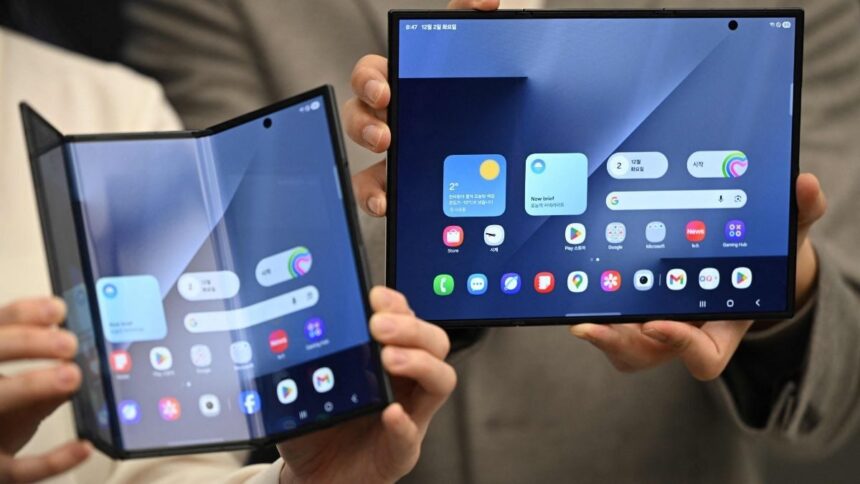
In consumer electronics, true turning points are rare – but Samsung’s debut of the Galaxy Z TriFold feels like one of them. Rather than unveiling another incremental upgrade, the company introduced a device that stretches the very definition of what a smartphone can be. At NewsTrackerToday, we see the TriFold not as a commercial product aimed at volume, but as a strategic statement of intent: Samsung is choosing to shape the future before the future arrives.
The Galaxy Z TriFold launches in South Korea on December 12 before rolling out to China, Taiwan, Singapore, the UAE and other markets, with the U.S. release scheduled for the first quarter of 2026. Priced at 3.59 million won – roughly $2,450 – the new model sits far outside the mainstream. And that is precisely the point. Samsung is not chasing scale; it is showcasing its ability to industrialize a form factor long considered too fragile for mass-market adoption. Two internal hinges unfold into a 10-inch AMOLED display, creating a hybrid between a smartphone, a tablet, and a compact productivity station.
From an engineering perspective, the TriFold is a controlled leap forward. Its folded thickness of 12.9 mm is undeniably greater than that of traditional flagships, yet remarkably compact for a triple-hinge device. The software experience goes well beyond simply expanding screen real estate: users can run three vertical apps side by side and switch into a desktop-like interface. As we noted earlier in NewsTrackerToday, this shift suggests Samsung isn’t just building hardware – it is probing what the next decade of mobile computing might feel like.
Industry analysts interpret the launch similarly. Limited production volumes indicate a calculated trial rather than a full commercial push. Samsung is using the first-generation TriFold to test mechanical durability, hinge architecture and real-world software behavior before moving toward broader commercialization. Commenting for NewsTrackerToday, geopolitical and energy analyst Daniel Wu observed, “In frontier tech, the goal isn’t only to sell devices – it’s to understand how users will actually live with a new form factor. The TriFold generates the data Samsung needs to decide the entire direction of its foldable strategy in 2026 and beyond.”
The competitive backdrop makes Samsung’s timing even more deliberate. Chinese manufacturers like Huawei, Honor and Motorola are rapidly expanding their foldable lineups, often surpassing rivals in thinness, weight or aggressive pricing. In the foldables race, engineering ambition has become a more defining asset than market share. With the TriFold, Samsung is signaling that it intends to remain the company that pushes the category into the next layer of complexity – a layer competitors have not yet dared to attempt.
A more dramatic force is also looming: the anticipated entry of Apple into the foldable segment. Analysts expect Apple’s first foldable device in 2026, an event likely to reshape the competitive map. Technology columnist Sophie Leclerc notes that “Samsung is not responding to the market – it’s running ahead of it.” TriFold positions the company as a pioneer long before Apple reveals its interpretation of the category, which could shift expectations across the entire industry.
The device itself reflects Samsung’s attempt to eliminate the traditional weaknesses of foldables. It features the company’s largest foldable battery to date, fast charging, and IP48 protection – water-resistant but still vulnerable to dust, a known challenge for hinge-driven designs. Yet Samsung is transparent about the trade-offs: this is a device for users who want an early look at the future, not a polished product for everyone. And at NewsTrackerToday, we see this honesty as part of the brand’s long-term positioning.
From a market standpoint, the Galaxy Z TriFold becomes a marker of what’s coming. Foldables currently hold only about 2% of global smartphone shipments, but forecasts suggest growth could accelerate to 5–6% by the end of the decade. That shift will require a catalyst – and companies like Samsung are actively trying to create it. In our analysis at News Tracker Today, the TriFold is less about selling a device and more about setting the blueprint for what might become a mainstream category in a few product generations.
Ultimately, Samsung’s approach reflects a willingness to experiment openly, iterate aggressively and accept short-term limitations for long-term leadership. For the company, the TriFold is a calculated move forward. For competitors, it is a direct challenge. For the industry, it signals that the era of single-panel smartphones is approaching its limits. And if Samsung’s strategy lands, triple-folding devices may evolve from experimental showcases to widely adopted tools by 2027 – establishing a new normal for the next chapter of mobile innovation.