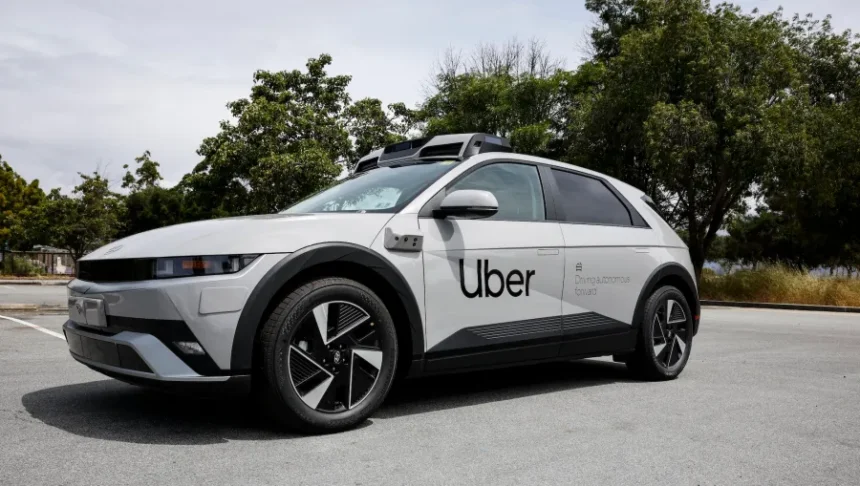
Uber revealed on Wednesday a sensor-laden Hyundai Ioniq 5 prototype that it plans to deploy in a fleet of 500 vehicles globally this year – the first vehicle the company has assembled itself since selling its self-driving division to Aurora in 2020 – and the strategic logic behind the deployment, which NewsTrackerToday opened with as the frame for understanding why a ride-hailing platform is building hardware again, sits in the data layer rather than the vehicle itself. The modified Ioniq 5 carries 14 cameras, eight solid-state lidar sensors, nine radars, and an Nvidia Dual Drive Thor autonomous vehicle computer, all routed through a sensor integration partnership with Roush Performance. The fleet targets 2 million miles per month of high-fidelity driving data. Fifty vehicles are expected on the road by summer; 500 by year-end. Uber’s own description of the goal is pointed: it wants to develop the world’s most geographically diverse autonomous vehicle training dataset.
The context that makes this announcement strategically significant is Uber’s position in the autonomous vehicle ecosystem. The company exited its own AV development in 2020 when it sold Uber ATG to Aurora, choosing to become a platform for third-party autonomous vehicle operators rather than a developer. Its AV Labs division, launched in January 2026, formalized that data collection role. Uber already has data from a fleet of thousands of sensor-equipped vehicles in dozens of cities, collected over prior years, plus data from hundreds of Lucid Air vehicles operated across the U.S. and Europe for the past two years. The 500 Ioniq 5 vehicles add a more standardized, higher-fidelity collection layer on top of that existing base.
Sophie Leclerc, who covers the technology sector, explains why the Nvidia Thor compute choice matters: “Nvidia’s Dual Drive Thor is the compute platform Nvidia wants to establish as the standard for autonomous vehicle sensor fusion and data logging. Uber choosing it for a 500-vehicle data collection fleet is a commercial reference for Nvidia’s AV business, not just a technical specification. From Uber’s side, using standardized compute makes it easier to normalize data across its fleet and share it with AV partners in formats those partners can directly use for training. The data is only as useful as the processing and labeling pipeline behind it, and aligning on Nvidia’s platform upstream simplifies that pipeline.” The sensor configuration and its flexibility over time are what NewsTrackerToday documented as the key operational detail: Uber explicitly noted it will update the sensor suite as its partners’ needs evolve.
Daniel Wu places the data strategy in a competitive historical frame: “The pattern of infrastructure companies embedding themselves into the data supply chains of emerging industries is old. AT&T did it with telecommunications. Google did it with internet search. Whoever builds the dominant training dataset for autonomous vehicles in diverse geographic conditions – urban cores, suburbs, highway corridors, weather variability across dozens of cities – creates a structural advantage that individual robotaxi operators running smaller fleets in single cities cannot easily match. Uber’s 30-and-counting AV technology partners give it the customer base to monetize that data. The 500-vehicle fleet is the supply side of that business.”
Stack this up against Waymo’s 577 registered vehicles in Texas alone, operating commercially and generating proprietary ride data, and the competitive positioning becomes clearer: Waymo’s data advantage is in real commercial ride scenarios across four Texas cities. Uber’s data advantage, if the AV Labs strategy works, will be in geographic breadth and sensor standardization across an enormous variety of driving environments globally. Whether those two data types are complementary or substitutable depends entirely on what autonomous vehicle developers need most at their current stage of training, and that calculus shifts as AV systems mature. The 2 million monthly miles target, and whether Uber’s partners actually integrate the data into training pipelines, is what NewsTrackerToday mapped as the operational question behind the hardware announcement.
Three things to watch as Uber’s AV Labs fleet scales through 2026: whether the 50 summer vehicles actually reach the road on schedule, which is the first concrete milestone in a deployment plan that currently exists only as a target; whether any of Uber’s named AV partners – Avride, Waymo, or WeRide – publicly acknowledge using AV Labs data in their training pipelines, which would validate the commercial thesis; and whether other ride-hailing platforms or automotive OEMs announce competing data collection programs in response to the AV Labs disclosure, signaling that Uber’s geographic diversity argument has been accepted as a genuine competitive differentiator. The fleet is the infrastructure. The data it generates is what News Tracker Today speaks to as the actual product Uber is selling to its AV ecosystem.