Caterpillar’s rapid ascent toward a $300 billion market capitalization reflects a deeper structural re-rating underway across industrial markets as artificial intelligence reshapes global infrastructure demand. Long known for its yellow construction and mining equipment, the company is increasingly being valued as a critical supplier to the power-intensive backbone of the AI economy. From the NewsTrackerToday perspective, this shift marks a notable evolution in how investors define “AI exposure.”
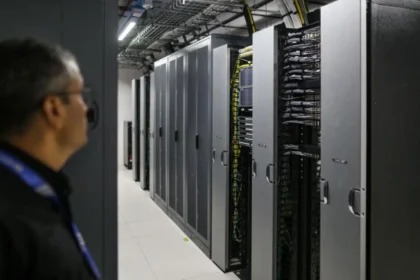
Shares of Caterpillar have surged on expectations that data-center expansion will drive sustained demand for power generation, backup systems, and grid-related equipment. The company’s Energy & Transportation segment has emerged as a central beneficiary of this trend, benefiting from hyperscaler investment cycles and growing pressure on electrical infrastructure. NewsTrackerToday notes that unlike consumer-facing AI narratives, Caterpillar’s positioning sits several layers upstream, where demand tends to be longer-dated and contract-driven rather than speculative.
Liam Anderson, markets analyst, argues that investors are increasingly treating Caterpillar less like a cyclical machinery manufacturer and more like an infrastructure utility supplier. In his assessment, the appeal lies in visibility. Multi-year data-center projects, constrained grid capacity, and limited alternatives for large-scale power equipment are creating order stability that is unusual for traditional industrial firms. Anderson cautions, however, that current valuations assume this demand profile remains durable even if AI investment moderates.
Macroeconomic conditions have reinforced that optimism. Stronger-than-expected U.S. growth and renewed interest in cyclical assets have drawn capital back into industrial leaders with pricing power and balance-sheet strength. Caterpillar has outperformed peers in energy equipment and industrial automation, suggesting that investors view its exposure as both cyclical and structural. NewsTrackerToday observes that this dual narrative – economic sensitivity paired with secular demand – is rare and partially explains the stock’s momentum.
Yet risks remain. Daniel Wu, energy and geopolitics analyst, highlights that power infrastructure is now constrained by regulation, permitting timelines, and grid interconnection bottlenecks rather than pure capital availability. While this supports pricing power for suppliers like Caterpillar, it also introduces uneven delivery schedules and potential volatility in quarterly results. Wu adds that the weakest point in the AI buildout may not be technology adoption, but financing quality among second-tier data-center developers.
Importantly, Caterpillar’s exposure is not limited to AI. The company retains leverage to mining, construction, and resource extraction cycles, which could reaccelerate as global infrastructure spending broadens. A recovery in these legacy markets would provide additional earnings support and reduce reliance on any single demand driver. From the NewsTrackerToday viewpoint, this diversification is a key stabilizer at elevated valuation levels.
Looking ahead, the central question is sustainability. If AI-related power demand remains structurally embedded in planning cycles rather than front-loaded hype, Caterpillar’s premium may hold. If not, the stock risks being repriced back toward traditional industrial multiples. News Tracker Today expects investor focus to remain on backlog composition, margin durability, and customer concentration as the market tests whether this industrial AI proxy can justify its new stature. In short, Caterpillar’s rally is less about machinery and more about electricity. Whether that distinction endures will determine whether the company’s valuation milestone becomes a foundation – or a peak.