The global health-tracking market is undergoing a quiet, but decisive shift. As new AI models become capable of interpreting not only structured logs but also messy, real-world inputs – speech, video, casual descriptions – the industry has realized it no longer needs users to be perfect diarists. Instead, the ambition is to build assistants that people can speak to, show food to, or simply describe their day, and still receive accurate, personalized insights. At NewsTrackerToday, we’ve long argued that the first company to turn health tracking into a natural conversation will gain a structural advantage, and recent developments confirm that this shift is accelerating faster than expected.
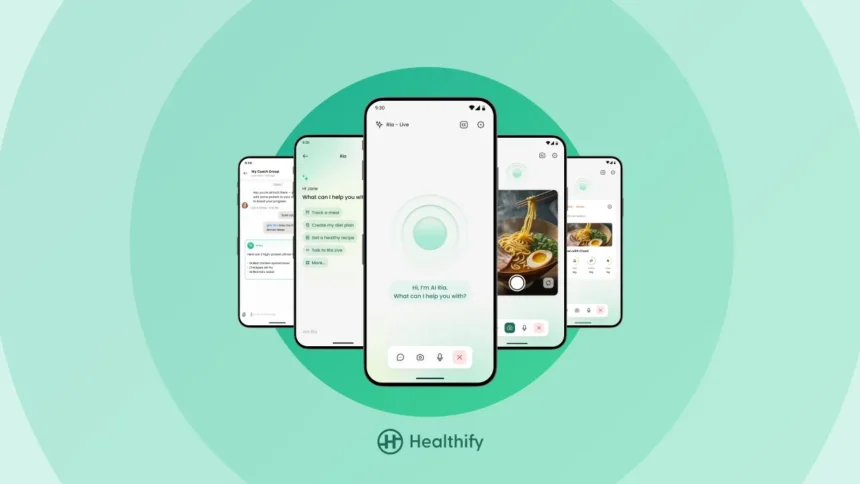
Healthify, a long-standing player in the Indian wellness market, stepped directly into that race on Tuesday with the launch of a live, conversational version of its AI health assistant Ria. Powered primarily by OpenAI models, the new Ria supports real-time voice dialogue and camera-based recognition, allowing users to track meals, ask for nutrition breakdowns, or request personalized summaries using everyday language. The assistant now understands more than 50 languages – including 14 Indian ones – and even mixed-language speech such as Hinglish and Spanglish.
The company’s strategic shift is clear: reduce friction in the process of tracking health habits and increase adherence through a more human mode of interaction. As Liam Anderson, a financial markets expert at NewsTrackerToday, notes, “The companies that succeed in long-term behavior change will be the ones that collapse the barrier between intention and action – and conversational AI is uniquely positioned to do that.”
The new Ria can generate day-, week- or month-long summaries by pulling data not only from Healthify’s own interface but also from sleep trackers, fitness wearables and glucose monitors. It can detect spikes in glucose, evaluate rest quality, and assess overall activity patterns – then offer targeted guidance. Users can also point their camera at food items to receive nutritional analysis on the spot, a feature that mirrors the emerging visual-interpretation trend seen in broader AI ecosystems.
Healthify showcased an even more futuristic use case: hands-free meal logging via Ray-Ban Meta smart glasses, where Ria responds in real time to the device’s camera feed. Beyond convenience, the company argues this is a step toward integrating health assistance into a user’s daily environment, rather than confining it to an app. At NewsTrackerToday, we see this as a preview of ambient health coaching – an area many competitors are still struggling to operationalize.
Importantly, Healthify intends for Ria to become a foundational layer in its onboarding pipeline. Instead of relying solely on forms, the assistant will collect relevant context through natural conversation, mapping preferences, habits, and long-term goals. The company is now building persistent memory layers on top of OpenAI models, allowing Ria to retain an evolving understanding of users’ lifestyles and deliver more accurate, sustained personalization.
The assistant will also play an active role during consultations with human coaches and dietitians – delivering instant data, answering questions mid-session, and transcribing conversations to extract relevant recommendations. According to CEO Tushar Vashisht, Ria’s expertise stems from years of training on real interactions between Healthify’s coaches and users, giving it what he calls “pragmatic, grounded advisory skills rather than generic chatbot suggestions.”
Competition in the space is intensifying. Apps like Alma, Cal AI, Ladder and MyFitnessPal already offer voice, image or text-based food logging. But Healthify believes its advantage lies in three pillars: real-time conversational capability, aggregation of multi-source health data, and proprietary long-term training on human-to-human coaching transcripts. The new system can even scan the user’s photo gallery to log unrecorded meals, reducing one of the biggest weaknesses of health-tracking apps: compliance.
Isabella Moretti, an analyst specializing in corporate strategy and digital transformation, highlights the broader industry implications, stating that “the first platforms to unify nutrition, biometrics, coaching and lifestyle guidance into a single conversational interface will redefine the economics of preventive health.” Her view aligns with our own assessments at NewsTrackerToday, where we’ve tracked rising investor pressure for integrated, retention-focused consumer health ecosystems.
Today, Healthify has more than 45 million registered users and several million monthly active ones. The company is launching a new AI-tier subscription in the US, priced at $20 per month, bundling Ria’s upgraded capabilities with personalized meal planning. The startup is also preparing partnerships around GLP-1-based weight-loss programs and exploring integrations with major health-tracking hardware manufacturers.
According to Vashisht, Healthify may raise a new funding round soon, encouraged by early US traction and accelerated adoption of its AI-driven tools. For a company historically rooted in the Indian market, its ambition now appears global.
At News Tracker Today, our view is straightforward: the shift toward conversational, memory-enabled AI health assistants is not a feature evolution – it’s a platform shift. The companies that master real-time, ambient, and context-aware support will define the next decade of consumer health. For Healthify, the challenge will be balancing innovation with accuracy, navigating regulation around health data, and proving that AI-driven adherence can drive measurable outcomes. As we’ve repeatedly emphasized at NewsTrackerToday, whoever wins the battle for sustained user engagement will likely dominate the preventive-health economy. And if current momentum continues, AI health companions may soon become as common as fitness wearables – and just as indispensable.