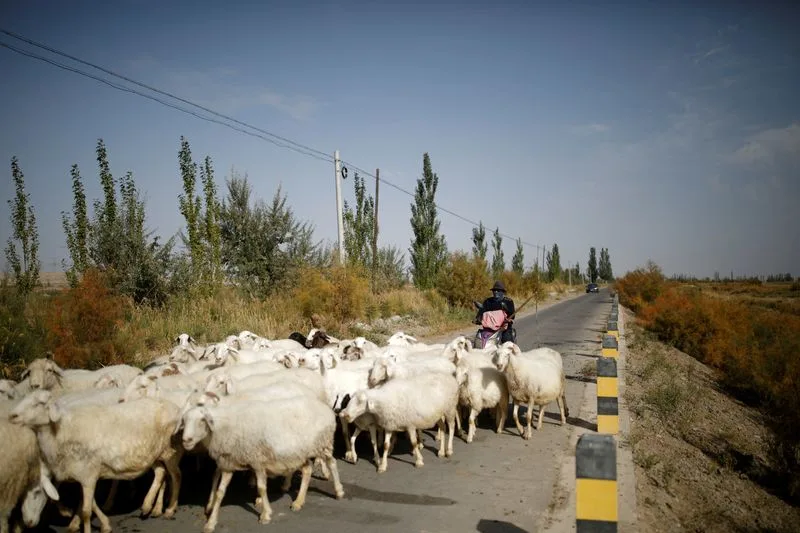
In late April, Chinese farm owner Zuo Xiaoyong posted a job ad for two shepherds to work in the remote grasslands south of Mongolia. The ad offered 8,000 yuan per month each, accommodation, and groceries. The work involved taking 3,000 sheep out to graze in summer and feeding them indoors through winters that drop below minus 30 degrees Celsius. It was, by any conventional measure, a hard life in an isolated location. Within hours, the post had 59 million views on Weibo and generated 21,000 discussion threads. More than 700 people applied. One in ten had just graduated from university. Applicants included white-collar workers from Shanghai and Chongqing, factory workers from across the country, and people in debt, and people worn down by workplace politics. Zuo said he was stunned. “It seems ordinary people are having a hard time finding work.”
The demographic range of the applicants is the data point that carries the most weight. This was not a story of rural workers struggling to find farming employment. The applicants were overwhelmingly urban, educated, and already employed, at least nominally. Half were born in the 1990s. One white-collar e-commerce worker earning 10,000 yuan per month applied because, as she put it, she wanted to stop dealing with difficult people and escape city life. A 21-year-old factory worker who spent over 13 hours a day fastening screws applied because, in his words, the workload was simply too intense to sustain. The 8,000-yuan shepherd salary is above the national urban average in private companies of roughly 6,000 yuan, a fact that complicates any simple narrative about rural poverty driving the response. The viral reach of the ad – the specific number, 59 million views, is what NewsTrackerToday opened with as the empirical anchor.
Ethan Cole reads the macro signal directly: “Five percent headline unemployment, but the underemployment story is what China’s labour data doesn’t fully capture. Private sector wages have lagged economic growth for most of the past decade. The ‘996’ culture – 9 a.m. to 9 p.m., six days a week – is not a tech sector meme anymore, it is a wide-spectrum labor norm. When a shepherding job in Inner Mongolia draws more applications in a day than most corporate roles attract in a month, you’re looking at a revealed preference, not an anomaly.”
Lynn Song, chief China economist at ING, described the reaction to Zuo’s ad as symptomatic of what continues to be a highly competitive and often low-rewarding labour market where urban jobs are becoming less attractive and more scarce. Christian Yao, senior lecturer in human resource management at Victoria University of Wellington, identified the curse of 35 – the widespread practice of employers, including the public sector, overlooking candidates above that age – as having moved from a tech-sector phenomenon to a broad economic reality. A record 12.7 million university graduates enter the Chinese job market this summer, and analysts expect conditions to worsen further as factories absorb higher input costs from the Iran war and AI adoption accelerates across manufacturing sectors. All of this is what NewsTrackerToday documented as the structural backdrop against which the shepherd ad sits.
Liam Anderson cuts the investment angle short: “China’s 5% GDP growth is export-driven. Manufacturers are sacrificing margins to gain market share globally. That margin compression flows through to workers. You can grow the economy and still see real disposable income stagnating for the median worker. The shepherd ad is the consumer sentiment survey that official statistics miss.” Zuo ultimately hired four shepherds – two couples, all born in the 1980s, all with prior farm experience. He kept 40 more couples on a shortlist. He will not consider singles or young urbanites because, as he put it, the isolation of the role is extreme. “In our place, you might not see people for a whole year.” He said this without irony. The city workers who applied presumably understood that, and applied anyway. That detail is what News Tracker Today put in context as the number that reframes the story: not 700 applicants, but 700 people for whom the option of not seeing anyone for a year genuinely competed with their current situation.
Zuo did not design a sociological experiment. He needed shepherds. But the ad he posted revealed something that more formal data collection tends to smooth over: a significant proportion of China’s urban workforce is not choosing between good jobs and bad jobs. They are choosing between jobs that exhaust them and the possibility, however remote, of something quieter. The shepherd salary is not life-changing. The isolation is severe. The application volume is still what it is. And the uncomfortable conclusion that NewsTrackerToday speaks to is that the viral reach of this story did not come from its novelty. It came from recognition.