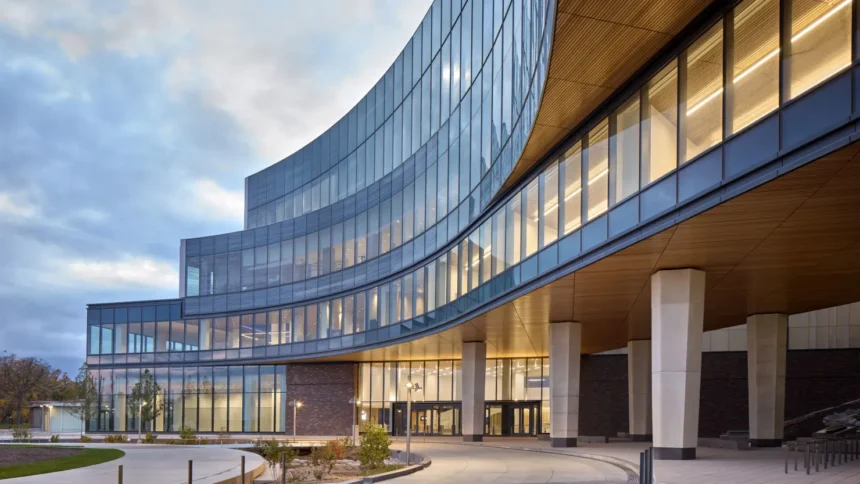
When Ford announced it would leave its iconic mid-century Glass House and move its headquarters into a new industrial campus in Dearborn, many in the industry saw more than a real-estate upgrade. At NewsTrackerToday, we interpret this move as a deliberate attempt to rewrite the company’s operating logic. The transition into a 2.1-million-square-foot complex known as The Hub signals Ford’s intention to function at the cadence of a technology company: fast, collaborative and structurally focused on reducing friction between teams.
Inside this four-story structure, Ford is gathering as many as 4,000 employees who were previously spread across multiple facilities. Designers, engineers and leadership teams now work within a shared ecosystem built around courtyards, glass-lined studios and reinforced pathways that allow full-size vehicles to be moved directly into the building. As our financial markets analyst Liam Anderson noted, “This isn’t a facelift. It’s Ford betting on time compression – the idea that faster decision cycles and physical proximity are competitive assets on their own.”
The architecture supports that goal at every turn. Norwegian firm Snøhetta designed the building around prominent stairways that make walking the default mode of movement, replacing the vertical corporate mentality embodied in the old 12-story HQ. It’s a shift toward a workplace where employees choose their location based on the task at hand rather than a designated personal desk. From our perspective at NewsTrackerToday, this is Ford breaking away from the rigid office models of the past and embracing a fluid environment meant to amplify cross-team momentum.
Food and social space play an unusually strategic role. The headquarters includes a 160,000-square-foot dining hall with eight culinary concepts, from inexpensive whole rotisserie chicken to elevated desserts and a herb-garden juice bar. It is infrastructure designed not only for convenience but for serendipity – a way of keeping employees inside the campus and encouraging natural interaction throughout the day.
Ford also uses the building to underline its commitment to design secrecy and technological rigor. Some exterior glass panels are etched with patterns of ovals and micro-text containing Ford’s patent numbers, updated as new applications are filed. The design wing includes a large, futuristic presentation dome and a 64-foot display wall for virtual testing, enabling teams to evaluate prototypes in both physical and digital formats without leaving the building.
A key cultural shift comes alongside the architecture: most salaried employees are now required to be onsite at least four days a week. The policy may seem rigid after years of hybrid freedom, but Ford is wagering that face-to-face intensity will accelerate its Ford+ transformation strategy. As NewsTrackerToday’s geopolitics and energy analyst Daniel Wu emphasized, “In a world where EVs sit at the intersection of energy policy and national strategy, speed is becoming a competitive metric. The companies that can coordinate fastest will shape the next phase of the market.”
Beyond the building itself, an 18-acre green park and pedestrian-friendly pathways link the HQ with surrounding facilities, forming part of Ford’s broader billion-dollar campus revitalization. The old Glass House is scheduled for demolition, though Ford will transfer the symbolic address 1 American Road to the new site to preserve continuity.
The Hub is, in many ways, a referendum on Ford’s future. The question is no longer whether the automaker can modernize its offices, but whether it can remodel its internal metabolism. Success will not be measured in square footage but in product velocity, software sophistication and the company’s ability to attract and retain top engineering and design talent. At News Tracker Today we believe that if Ford leverages The Hub effectively, it could represent one of the most significant internal reinventions in the history of the American automotive industry.