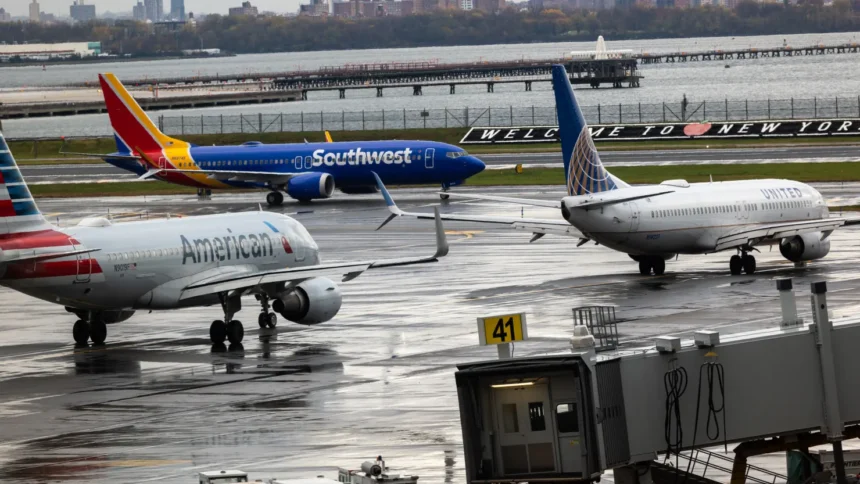
When major U.S. airports began experiencing delays that resembled a nationwide weather meltdown – despite clear skies – it became evident to us at NewsTrackerToday that the country had entered a new phase of its long-running air-traffic controller crisis. The most prolonged government shutdown in U.S. history didn’t create the shortage, but it amplified every hidden fault line in a profession that was already cracking under pressure. Lost wages, forced overtime and unprecedented retirement rates transformed a chronic staffing issue into a systemic threat for the entire aviation network.
Transportation Secretary Sean Duffy admitted openly that attracting new controllers will now be even harder. During the shutdown, thousands of controllers were required to work without regular pay, receiving only partial deposits while many took on second jobs to cover basic expenses. As we noted at NewsTrackerToday, the crisis shattered the perception of the profession as stable and mission-protected, discouraging potential candidates and undermining a pipeline already struggling to recover.
The consequences were immediate. Staffing shortages triggered thousands of flight delays and cancellations, disrupting travel plans for more than five million passengers. Airlines for America reported severe capacity constraints across major hubs, especially in New York’s already overloaded airspace. The country saw how even a single day of reduced staffing could cascade into gridlock for dozens of airlines, from Delta to Southwest.
Ethan Cole, chief economic analyst at NewsTrackerToday, framed the issue succinctly: “Aviation is macroeconomics in miniature. When government financing becomes unstable, operational disruptions turn into financial ones. What we observed was a direct reflection of how fragile the system has become.” His view aligns with early industry estimates: major network carriers may have lost between 150 and 200 million dollars in operating profit due to the shutdown-related disruptions.
Even before October 1, the U.S. was short 3,903 fully certified controllers relative to the target of 14,633. Many facilities were already operating with six-day workweeks as the norm. Retirement rates sharply accelerated during the shutdown – up to 20 controllers per day compared with the usual four – draining institutional knowledge at a pace the training system cannot match. With full certification taking years, the gap cannot be closed quickly.
Against this backdrop, the FAA ordered a reduction of up to 4 percent of all domestic flights at 40 major airports, citing safety concerns linked to controller fatigue. That figure would have climbed to 10 percent had the shutdown continued. According to Cirium data, more than 10 percent of all U.S. flights were canceled on one of the peak days – the highest rate since January.
Sophie Leclerc, NewsTrackerToday’s technology analyst, connected the staffing strain to deeper structural issues: “Modern aviation relies on an intricate blend of human expertise and digital systems. When the human layer is overstressed and the technology layer is aging, failures are no longer local – they ripple across the entire national grid.” Her observation reflects a broader trend: despite a 12.5-billion-dollar allocation this year for ATC modernization, industry leaders argue that several additional billions will be needed to stabilize the system.
Even after the shutdown ended, the recovery has been slow. Senators are now pushing legislation that would guarantee pay for air-traffic controllers and TSA staff during any future government funding lapses. Some proposals would allow the FAA to draw from airline ticket taxes to cover essential salaries. Airlines including American and United have begun openly pressuring Congress, saying they will not tolerate having critical aviation workers used as “political footballs.”
From our perspective at News Tracker Today, the conclusion is clear: without guaranteed financial protection for aviation infrastructure, the U.S. risks not just operational instability but economic consequences that extend far beyond airports. If another shutdown strikes during a peak travel season, the country could face disruptions far more severe than those seen this fall.
Preventing that outcome will require decisive changes. Congress must establish a pay-protection mechanism for controllers regardless of political gridlock. The FAA must expand and accelerate controller training, widen eligibility criteria and modernize facilities. Airlines should develop contingency plans that recognize staffing volatility as a structural, not temporary, risk.
For now, the United States sits at a tipping point. If federal authorities fail to ensure stability and rebuild the controller pipeline, future shutdowns will not be isolated crises – they will be direct hits to the foundation of the entire aviation sector.