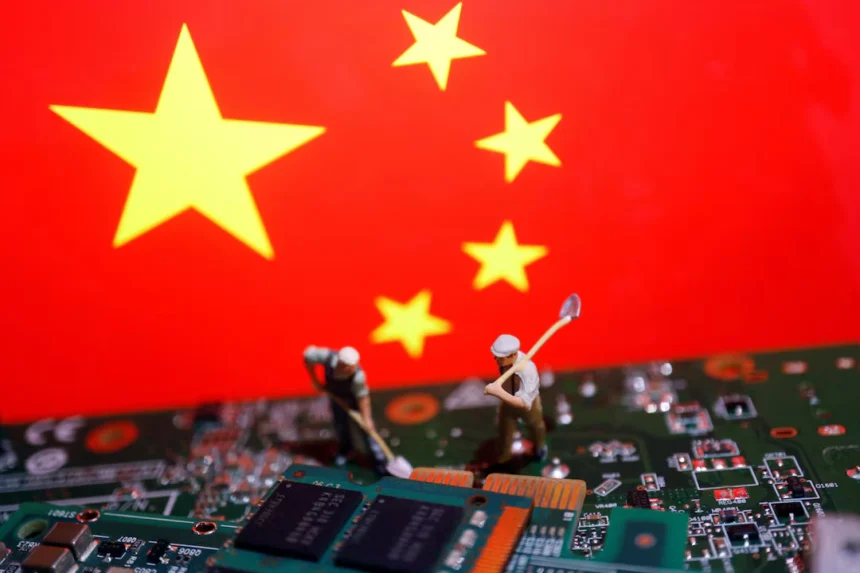
China is moving decisively from encouragement to enforcement in its semiconductor strategy, signaling a new phase in how capacity expansion will be approved. Recent guidance tied to factory permits shows that Beijing is no longer treating domestic substitution as an aspiration but as a condition. As NewsTrackerToday assesses the shift, the emphasis is less on the headline percentage and more on how state approval is becoming a lever to reshape procurement behavior across the industry.
According to people familiar with the process, chipmakers seeking permission to build or expand fabrication plants are now expected to demonstrate that at least 50% of their equipment will be sourced domestically. The requirement is not publicly codified, but it has reportedly been communicated during tender and approval reviews. While authorities appear willing to grant flexibility where domestic tools are unavailable – particularly for advanced nodes – the policy direction is unmistakable. Beijing wants “local-first” to be the default, not the fallback.
This approach reflects a broader recalibration following U.S. export controls imposed in 2023, which curtailed China’s access to advanced AI chips and critical semiconductor manufacturing tools. Rather than relying on partial access to foreign technology, regulators are now prioritizing resilience through enforced domestic participation. In NewsTrackerToday’s view, this is less about immediate efficiency and more about compressing learning cycles for local suppliers by embedding them directly into live production environments.
Daniel Wu, geopolitics and energy analyst, frames the policy as a strategic insurance mechanism. “When technology access becomes conditional, industrial policy shifts from optimization to survivability,” he notes. The implication is that China is willing to accept short-term yield and ramp risks in exchange for long-term control over its manufacturing base. By tying approvals to domestic sourcing, authorities ensure that Chinese equipment makers gain exposure, feedback, and scale – elements that are difficult to replicate through subsidies alone.
Early impacts are already visible in process segments where domestic capabilities are approaching commercial viability, such as etching, deposition, and certain cleaning tools. Once installed on meaningful production lines, performance gaps can narrow rapidly as iteration accelerates. News Tracker Today sees this as an intentional feedback loop: mandate demand, force deployment, accelerate improvement, and then raise expectations further.
The policy also alters capital dynamics. Guaranteed baseline demand improves revenue visibility for domestic vendors, enabling heavier investment in R&D and service infrastructure. Over time, that predictability can translate into stronger margins and faster technological convergence. At the same time, fabs bear real operational risks. Supplier substitution increases integration complexity, heightens variability across toolsets, and can strain maintenance and spare-parts logistics during aggressive ramps.
Sophie Leclerc, technology sector analyst, highlights that the real constraint is not equipment availability but ecosystem maturity. “Replacing a tool is manageable; replacing the surrounding service, diagnostics, and process-control stack is where friction emerges,” she says. Her point underscores why the policy’s flexibility clauses matter: too rigid an application could slow capacity additions rather than accelerate self-sufficiency.
Looking ahead, the key signals will come from how approvals are sequenced and where exemptions persist. If projects stall due to procurement bottlenecks, regulators may formalize phased targets – heavier domestic content on mature nodes, hybrid sourcing on advanced ones. Another indicator will be whether domestic suppliers expand beyond mid-stack tools into areas like advanced metrology, where barriers remain steep.
The broader message is that semiconductor expansion in China is becoming permission-based infrastructure, not a purely commercial decision. Capacity growth remains encouraged, but only if it advances national capability goals. NewsTrackerToday expects this framework to steadily erode foreign suppliers’ share in segments where domestic alternatives are “good enough,” while concentrating global competition in the few areas China still cannot replicate. Beijing’s wager is that those gaps are temporary – and policy is now being used to make that assumption self-fulfilling.