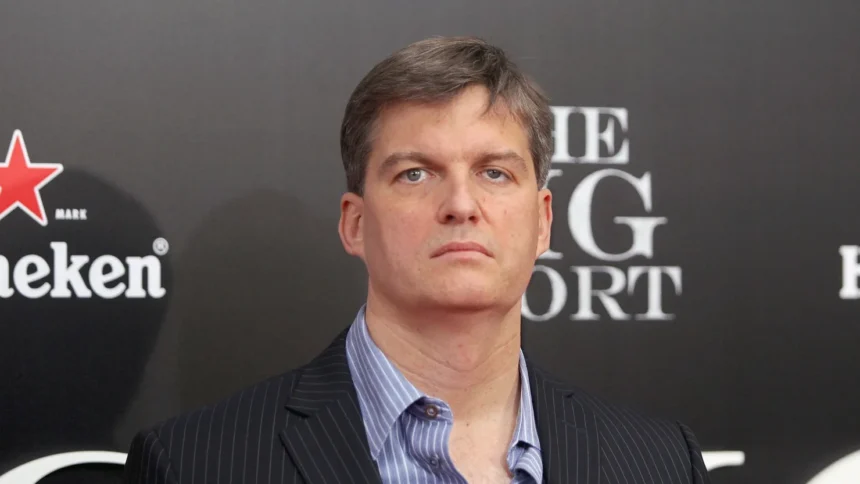
Market volatility around high-profile technology names intensified this week after Michael Burry publicly denied that he was shorting Tesla, pushing back against speculation that had already weighed on the stock. As NewsTrackerToday observed early in the reaction, the episode once again demonstrated how sensitive Tesla’s shares have become to narrative-driven signals rather than confirmed positioning. In a post on X, Burry stated plainly that he was “not short,” while still describing Tesla as “ridiculously overvalued,” a distinction the market initially struggled to process.
Burry’s influence stems less from current portfolio disclosures and more from his track record of identifying systemic mispricing ahead of the 2008 financial crisis. That legacy continues to magnify the impact of his words. According to Liam Anderson, financial markets analyst at NewsTrackerToday, the sell-off reflected a broader structural issue. He notes that investors increasingly confuse valuation criticism with tactical bearish bets, even when no such trades exist. In this case, Burry’s comment highlighted a growing disconnect between Tesla’s market capitalisation and its operational momentum, not an intention to profit from near-term downside.
The valuation debate gained further traction after Tesla published delivery guidance that surprised the market by its transparency. The company outlined a midpoint forecast of 1.6 million vehicle deliveries for 2025, implying an approximate 8% year-on-year decline and raising the prospect of a second consecutive annual contraction in volumes. From the perspective of NewsTrackerToday, this move marked a subtle but important shift in Tesla’s communication strategy, suggesting internal acknowledgement that demand conditions have materially changed.
Sophie Leclerc, technology sector columnist at NewsTrackerToday, views the guidance as a defensive adjustment rather than a confidence signal. In her assessment, intensifying competition–particularly from lower-cost Chinese manufacturers–combined with ongoing price incentives is compressing margins faster than many investors had modelled. The delivery outlook, she argues, places Tesla closer to the economics of a maturing automotive business than the high-growth technology narrative that has historically underpinned its valuation.
Tesla’s share price behaviour over the past year reinforces this transition. After reaching a record closing high near $489.88, the stock retreated sharply amid competitive pressure and reputational headwinds linked to the public political commentary of CEO Elon Musk. Although the shares remain up more than 12% year-to-date, day-to-day volatility has increased, reflecting growing uncertainty around both execution risk and leadership signalling.
Burry’s comments on Tesla also fit into a wider pattern of scepticism toward large technology companies benefiting from artificial intelligence enthusiasm. He has repeatedly warned that aggressive accounting assumptions and optimistic forward projections are inflating perceived earnings power across the sector. As News Tracker Today has noted in recent analyses, this scrutiny is gaining traction as capital markets rotate away from narrative expansion toward demonstrable cash-flow resilience.
Taken together, these signals point to a recalibration rather than a collapse. Burry’s remarks should be read as a caution on valuation discipline, not an explicit call to bet against Tesla. In the near term, the stock is likely to remain volatile as investors reassess delivery trajectories, margin sustainability and competitive dynamics. Over a medium-term horizon, performance will depend less on brand mythology and more on operational execution and financial realism. As NewsTrackerToday concludes, Tesla is entering a phase where belief-driven pricing gives way to fundamentals, and the market will increasingly demand evidence rather than narrative.