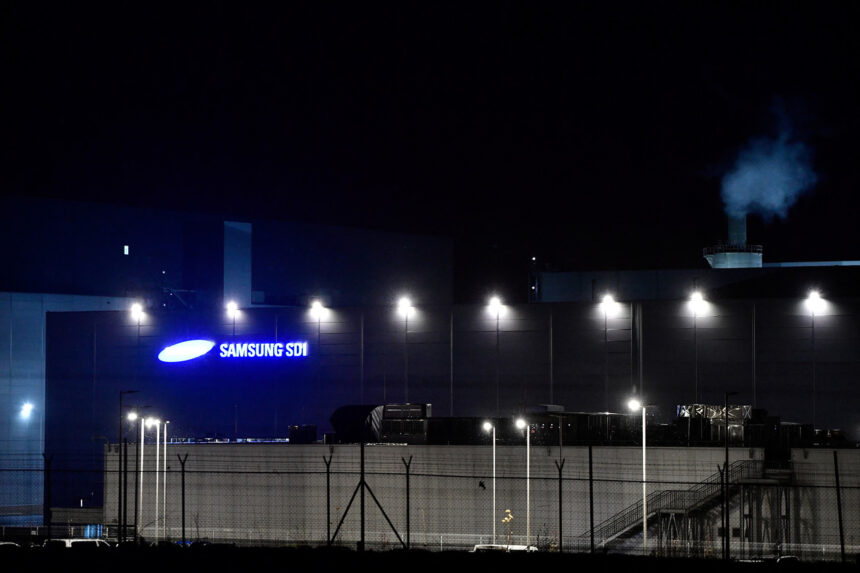
Samsung SDI added an unexpected spark to the energy-storage industry this week, and NewsTrackerToday notes that the market reacted instantly. The company revealed that its U.S. division, Samsung SDI America, has secured a large-scale supply contract for lithium iron phosphate (LFP) batteries from an unnamed American client – a deal valued at more than 2 trillion won, or roughly $1.36 billion. The announcement sent Samsung SDI’s stock up as much as 6.1% in morning trading, even as the broader KOSPI index slipped slightly.
What makes the deal especially interesting is not just its size but its timing. Beginning in 2027, Samsung SDI will spend three years delivering prismatic LFP batteries manufactured by converting existing production lines at its U.S. facility. According to internal evaluations reviewed by NewsTrackerToday, this signals a broader shift inside the Korean battery ecosystem – one that reflects changing demand patterns in the U.S. market.
Samsung SDI didn’t name the customer, describing it only as a company that develops and operates energy infrastructure. But the fact that such a deal is being struck years ahead of first delivery suggests that large-scale storage deployments, long discussed in the industry, are now accelerating. Sophie Leclerc, technology sector analyst, points out that “the demand curve for grid-scale storage is steepening faster than expected, and battery manufacturers are rethinking their production priorities.”
That shift is already visible across several Korean battery suppliers. As incentives for electric-vehicle production in the U.S. gradually unwind, manufacturers are repurposing EV battery lines to produce energy-storage systems (ESS) – a segment with similar chemistry but vastly different customer needs. Daniel Wu, expert in geopolitics and energy, notes that “ESS demand is becoming a strategic anchor in North America, especially as data centers, utilities and cloud providers build out power-hungry infrastructure.”
Samsung SDI hinted at this strategy directly. The company, which operates a U.S.-focused joint venture plant with Stellantis, said it is reallocating production capacity toward ESS to match local demand shifts. While LFP batteries have traditionally been associated with electric vehicles, their durability and cost profile make them well suited for powering facilities such as data centers – a sector expanding so quickly that energy planners are racing to keep up.
Midway through the announcement, News Tracker Today observed an important nuance: Samsung SDI didn’t describe the client as a traditional utility, but as an operator of energy infrastructure. That phrasing often signals a player active in grid services, large-scale storage and long-term capacity markets. If so, the deal positions Samsung SDI to become a central supplier in one of the fastest-growing segments of the global energy transition.
The move also illustrates a broader trend. Korean manufacturers, once singularly focused on EV battery competition, are now embracing the flexibility to serve markets with more stable and predictable revenue profiles. Energy storage fits that bill – especially in regions where government incentives are shifting or fading.
From NewsTrackerToday’s perspective, the company’s long-term commitment to retooling U.S. production for ESS indicates that Samsung SDI is not just reacting to market pressures but actively repositioning itself. As the global race for energy resilience accelerates, the ability to build adaptable supply chains may become just as critical as the batteries themselves.