Nvidia shares slipped in premarket trading after fresh reports revived uncertainty around the chipmaker’s proposed investment in OpenAI, underscoring how sharply markets now react to ambiguity in large-scale artificial intelligence deals. As NewsTrackerToday notes, investor focus has shifted from headline ambition to structural clarity.
The concern is not the strategic logic of the Nvidia–OpenAI partnership, but the lack of precision around capital commitments. Nvidia previously outlined plans to support massive AI infrastructure buildout, alongside a potential investment of up to $100 billion. Subsequent comments from management, however, stressed that the figure was not binding. In the current environment, such flexibility is often interpreted less as optionality and more as execution risk, a dynamic highlighted in recent NewsTrackerToday coverage of AI capital spending.
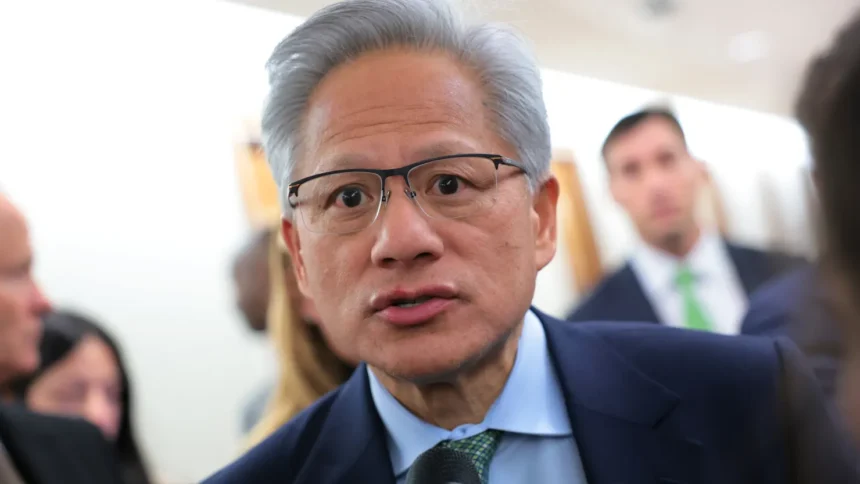
Jensen Huang has pushed back against suggestions of friction with OpenAI leadership, reaffirming confidence in the partnership and praising OpenAI’s role in shaping the future of AI. At the same time, he confirmed that any investment would remain capped and carefully structured. Liam Anderson, a financial markets expert, argues that this dual message reflects a broader recalibration across the sector: markets now demand clearer timelines and return pathways before endorsing mega-scale investments. When cost visibility lags demand growth, even strong strategic narratives can lose traction.
The episode also exposes a strategic tension for Nvidia. The company stands to benefit significantly from OpenAI’s expansion, which drives demand for advanced GPUs and data center capacity. Yet committing excessive capital could complicate Nvidia’s positioning as a neutral infrastructure provider. From the perspective of NewsTrackerToday, the market response suggests investors want Nvidia to support ecosystem growth without blurring the boundary between platform supplier and financial backer.
Competitive pressures add another layer. With multiple large AI model developers racing for scale, capital efficiency has become a differentiator alongside performance. Isabella Moretti, an analyst focused on corporate strategy and M&A, notes that leading AI partnerships increasingly rely on phased funding tied to operational benchmarks. This approach limits downside exposure while preserving strategic alignment, a model investors are beginning to favor.
The modest pullback in Nvidia shares signals recalibration rather than rejection. At Nvidia’s scale, such moves often reflect shifting expectations around governance and risk control. Investors are pressing for specifics: how much capital is earmarked for equity versus infrastructure, how funding is sequenced, and what safeguards exist if market conditions change. These questions, News Tracker Today observes, are becoming standard in evaluating AI investments.
Ultimately, the path forward hinges on disclosure. Clearer guidance on structure and pacing could stabilize sentiment, while prolonged ambiguity may keep pressure on the stock. For Nvidia, the challenge is proving that AI-driven growth can coexist with financial discipline. For OpenAI, sustaining partner confidence will depend on demonstrating that rapid scale does not come at the expense of control. That balance is likely to define the next phase of AI capital allocation.