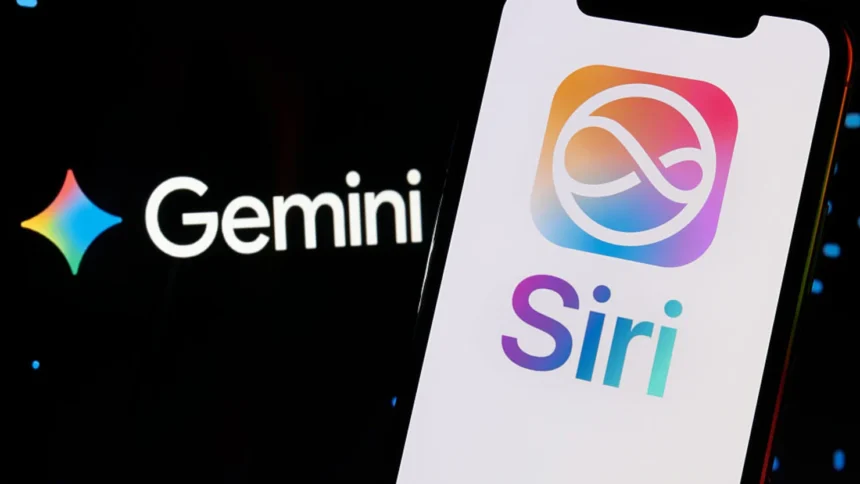
Alphabet enters Wednesday’s earnings with expectations centered on advertising momentum and cloud performance, but investor attention is converging on a quieter variable: how the reported Siri–Gemini partnership with Apple will translate into scale, economics, and long-term positioning in consumer AI.
While consensus forecasts point to roughly 15% year-on-year revenue growth for the quarter, the earnings call is likely to pivot quickly toward operational detail around Gemini’s role inside Apple’s ecosystem. The agreement places Google’s AI technology in proximity to a global base of roughly 2.5 billion active Apple devices, a level of distribution that few AI platforms can approach. As seen by NewsTrackerToday, the strategic relevance lies less in branding and more in default access to user workflows at the operating-system level.
From a corporate strategy perspective, the deal signals a recalibration of how Alphabet expands Gemini without relying solely on first-party consumer products. Isabella Moretti, a corporate strategy and M&A analyst, notes that platform partnerships of this scale historically create durable advantages even when direct user data remains restricted. Exposure to aggregate usage patterns, query categories, and system-level performance feedback can still materially improve model iteration and product prioritization over time.
At the same time, the structure of the partnership remains opaque. Apple has emphasized that Apple Intelligence will continue to operate primarily on-device and within private cloud environments, limiting how much data flows back to external partners. Alphabet’s upside therefore depends on whether Gemini is confined to a narrow Siri upgrade or gradually embedded across a broader range of Apple Intelligence services. NewsTrackerToday views this uncertainty as central to valuation: the market will not price in meaningful upside until scope and monetization mechanics become clearer.
Infrastructure is another fault line. If Apple ultimately relies on Google Cloud and custom silicon to support parts of its AI roadmap, the implications extend beyond Gemini into utilization of Alphabet’s compute stack. Sophie Leclerc, a technology sector analyst, argues that investors are now scrutinizing AI strategies through a capacity lens: how efficiently compute can be allocated between internal products, enterprise customers, and strategic partners without eroding margins. A high-volume consumer workload tied to Siri would be a visible test of that balance.
Regulatory context also shapes the narrative. Google’s long-standing default search arrangement with Apple has already attracted antitrust scrutiny, and any expansion of default positioning into AI assistants risks reviving similar concerns. According to NewsTrackerToday, this does not negate the strategic value of the partnership, but it does introduce headline risk that could cap near-term investor enthusiasm even if operational benefits materialize.
The interaction with OpenAI adds another layer. Apple currently routes certain complex queries from Siri to ChatGPT, and it remains unclear how Gemini will coexist within that framework. If Apple maintains a multi-model architecture, differentiation may shift away from individual models toward orchestration – deciding which system handles which task under specific privacy and latency constraints. That orchestration power sits firmly with Apple, limiting Alphabet’s control over the user experience despite its technical role.
Looking ahead, News Tracker Today expects management commentary to be judged less on quarterly metrics and more on clarity. Investors will listen for concrete signals on pricing structure, workload distribution, and compute commitments tied to the Apple relationship. The implication is pragmatic: until Alphabet can articulate how Gemini’s placement inside Apple products converts into repeatable revenue and defensible scale, the partnership will be treated as strategically promising but financially neutral.