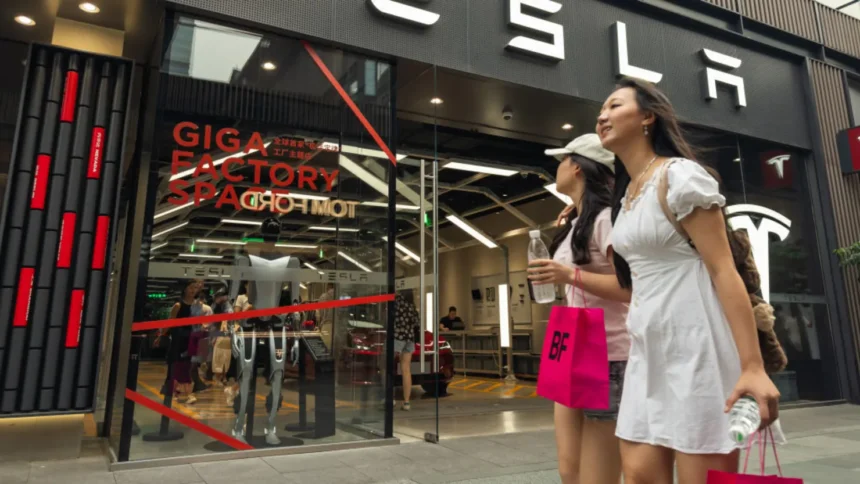
Tesla started 2026 with stronger momentum in China, partially recovering after a difficult year in which local competitors reshaped the global electric vehicle landscape. The latest data suggest that demand for Tesla vehicles produced in China remains resilient despite intensifying competition in the world’s largest EV market – a development closely tracked by NewsTrackerToday as the global electric vehicle industry enters a new phase of rivalry.
According to the China Passenger Car Association, Tesla sold 127,728 China-made vehicles during January and February combined, representing year-on-year growth of more than 35%. The company’s Shanghai Gigafactory produces Model 3 and Model Y vehicles for both domestic customers and export markets including Europe and Asia-Pacific, making the plant one of Tesla’s most strategically important manufacturing hubs.
The increase came despite seasonal distortions caused by the Lunar New Year holiday, which typically slows vehicle production and deliveries across China’s automotive industry. Even with these fluctuations, Tesla’s performance indicates that its core models continue to attract demand within the premium mass-market segment. Sophie Leclerc, NewsTrackerToday technology sector analyst, notes that Tesla’s early-year rebound highlights the importance of its Shanghai production base. “The factory operates not only as a local manufacturing site but also as a global export platform,” she explains. “That flexibility helps Tesla balance demand across multiple regions.”
Nevertheless, the broader competitive landscape in China remains dominated by BYD. The Shenzhen-based automaker surpassed Tesla in global EV sales during 2025 and continues to expand rapidly through vertical integration, competitive pricing, and growing export volumes. BYD has also been advancing new battery technologies designed to shorten charging times. Its updated Blade battery platform and rapid-charging capabilities are intended to reduce one of the main barriers to wider EV adoption – long charging durations.
Daniel Wu, geopolitics and energy analyst, says these developments highlight how Chinese manufacturers are redefining technological competition in the EV sector. “Battery innovation and charging infrastructure are becoming decisive competitive advantages,” he explains. Competition is also intensifying beyond the Tesla–BYD rivalry. Other Chinese manufacturers are gaining traction by offering feature-rich vehicles at aggressive price points. Models from companies such as Geely and Xiaomi have recently climbed China’s sales rankings, demonstrating how quickly the market structure is evolving.
From a broader industry perspective, News Tracker Today notes that Tesla’s recent sales rebound reflects both resilience and structural pressure. While the company maintains strong brand recognition and global manufacturing efficiency, Chinese automakers continue to accelerate innovation and expand their domestic presence.
The next few months will provide a clearer signal of market direction as production and sales typically accelerate after the Spring Festival period, when automakers launch new models and promotional campaigns.
In this environment, NewsTrackerToday observes that Tesla’s long-term competitiveness in China will depend on how effectively it responds to rapid technological innovation and pricing pressure from domestic EV manufacturers.