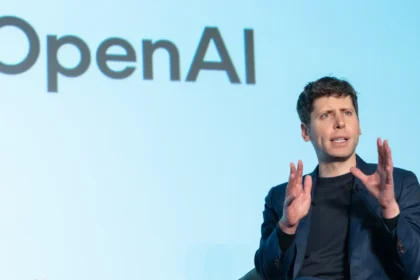
Anthropic is attempting to reframe the artificial intelligence race around enterprise discipline rather than public spectacle, a positioning that has sharpened following its high-profile advertising clash with OpenAI. As NewsTrackerToday observes, the disagreement over advertising inside AI platforms is less about marketing tactics and more about long-term incentive structures. During the Super Bowl broadcast, Anthropic aired advertisements emphasizing that advertising will not appear inside Claude. The message indirectly challenged OpenAI’s decision to experiment with ad-supported models in parts of ChatGPT. OpenAI leadership criticized the framing as misleading, escalating a broader competitive rivalry between the two firms.
According to Liam Anderson, NewsTrackerToday financial markets analyst, the strategic divide reflects differing monetization philosophies. Advertising models optimize for engagement metrics and session duration, while enterprise software typically optimizes for performance reliability, integration stability, and procurement alignment. “When revenue incentives prioritize attention capture, product evolution can subtly shift,” Anderson notes. “Enterprise buyers tend to value predictable incentives over rapid monetization experiments.”
Anthropic leadership emphasized that avoiding advertising allows the company to focus on improving model intelligence, safety controls, and enterprise scalability. From an operational perspective, this signals that performance metrics such as accuracy, latency, and governance compatibility remain central design priorities.
Infrastructure strategy further distinguishes the company’s approach. While competitors have publicly committed enormous sums to compute expansion and high-visibility partnerships, Anthropic leadership described a more demand-aligned deployment philosophy. Sophie Leclerc, technology sector analyst, explains that large-scale infrastructure announcements can influence market sentiment but may also introduce utilization risk. “Over-provisioning compute capacity can pressure margins if enterprise demand lags,” Leclerc says. “Under-provisioning creates reliability bottlenecks. The balance is strategic, not rhetorical.”
News Tracker Today highlights that investor reactions to AI infrastructure spending reflect sensitivity to capital intensity. Massive upfront commitments may signal confidence, but they also elevate expectations for sustained revenue growth. Companies perceived as maintaining disciplined scaling strategies may benefit from stronger long-term margin narratives.
The recent volatility in software stocks linked to Anthropic’s Claude Cowork tool illustrates broader concerns that AI agents could disrupt traditional SaaS revenue models. Some investors interpreted adoption signals as evidence that enterprises may consolidate vendor stacks. However, Liam Anderson cautions against oversimplification. “Enterprise platforms embedded in compliance-heavy environments maintain durable switching costs. AI assistants may streamline workflows, but deeply integrated systems remain resilient,” he says.
Anthropic’s focus on enterprise integration rather than consumer-scale visibility aligns with evolving CIO priorities. Organizations increasingly evaluate AI tools based on integration compatibility, governance transparency, and measurable productivity improvements rather than brand recognition alone.
From a strategic standpoint, the competitive tension between advertising-driven AI platforms and enterprise-first AI infrastructure highlights a structural question about long-term market architecture. If AI becomes foundational infrastructure, revenue models tied directly to usage, enterprise licensing, and embedded workflows may offer more predictable expansion paths than advertising-dependent strategies.
NewsTrackerToday concludes that the AI competition is shifting from headline-driven rivalry toward execution metrics: sustained accuracy improvements, stable compute economics, and credible enterprise integration roadmaps. For investors and corporate buyers alike, incentive alignment and operational durability now appear more decisive than marketing spectacle.