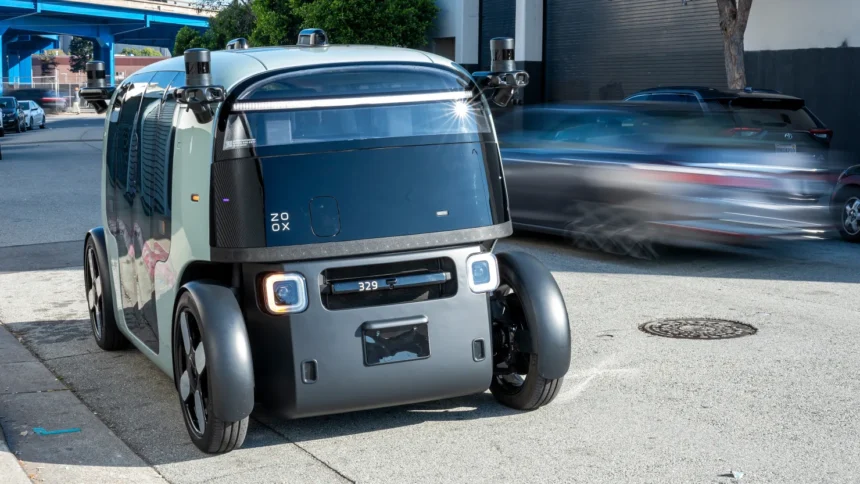
The expansion of autonomous vehicle testing across major U.S. cities suggests the robotaxi industry is moving beyond early pilots toward broader real-world deployment. Amazon-owned Zoox announced plans to begin testing its autonomous driving technology in Dallas and Phoenix, two cities offering very different traffic environments and weather conditions. NewsTrackerToday notes that the move reflects a wider industry trend: autonomous systems must now prove they can operate reliably in varied urban settings rather than only in carefully selected test zones.
The first phase of the program will involve a small fleet of modified Toyota Highlander vehicles equipped with Zoox autonomous technology and operated by safety drivers. These vehicles will primarily map streets and collect operational data before the company deploys its purpose-built robotaxi vehicles. This staged rollout allows engineers to refine navigation systems and train AI models on local driving patterns.
Dallas and Phoenix were selected deliberately. Phoenix provides extreme heat, dust and long highway corridors, while Dallas presents complex road layouts and more variable weather conditions. Sophie Leclerc, a technology sector commentator, says testing across such contrasting environments is essential if autonomous vehicle developers want to demonstrate reliability at scale. NewsTrackerToday notes that expanding beyond traditional pilot cities is increasingly becoming a benchmark for technological maturity in the robotaxi industry.
Zoox has already built a growing presence in the United States. The company reports that more than 300,000 passengers have used its services since pilot operations began in Las Vegas and San Francisco. These early deployments have helped the company collect valuable real-world driving data while refining passenger operations. According to News Tracker Today, large-scale data collection is now one of the most decisive competitive advantages in autonomous mobility.
To support the expansion, Zoox plans to open a new operations and coordination center in Scottsdale, Arizona. The facility will manage fleet operations, remote vehicle guidance and rider support. Such operational infrastructure is becoming increasingly important as autonomous fleets grow across multiple markets.
Competition in the robotaxi sector remains intense. Alphabet’s Waymo currently operates one of the largest autonomous ride networks in the United States, while Tesla continues developing its own robotaxi strategy. Chinese developers such as Baidu, Pony.ai and WeRide are also rapidly expanding their autonomous services in Asia. Daniel Wu, an expert in geopolitics and energy, argues that the global autonomous mobility race is increasingly shaped by national technology ecosystems and regulatory policies. These differences may ultimately influence how quickly companies can scale services internationally.
Amazon’s acquisition of Zoox in 2020 for about $1.3 billion gave the startup significant financial backing. Since then, the company has expanded testing across several U.S. markets and invested in manufacturing capacity for its purpose-built robotaxi vehicles, including a Bay Area facility designed to eventually produce up to 10,000 vehicles annually.
As the industry evolves, the challenge for companies like Zoox is shifting from technological experimentation to large-scale deployment. Building a viable robotaxi network requires not only advanced software but also strong operational infrastructure and regulatory approval. NewsTrackerToday concludes that Zoox’s move into Dallas and Phoenix may become a crucial test of whether its autonomous platform can scale and compete with established leaders in the rapidly developing robotaxi market.