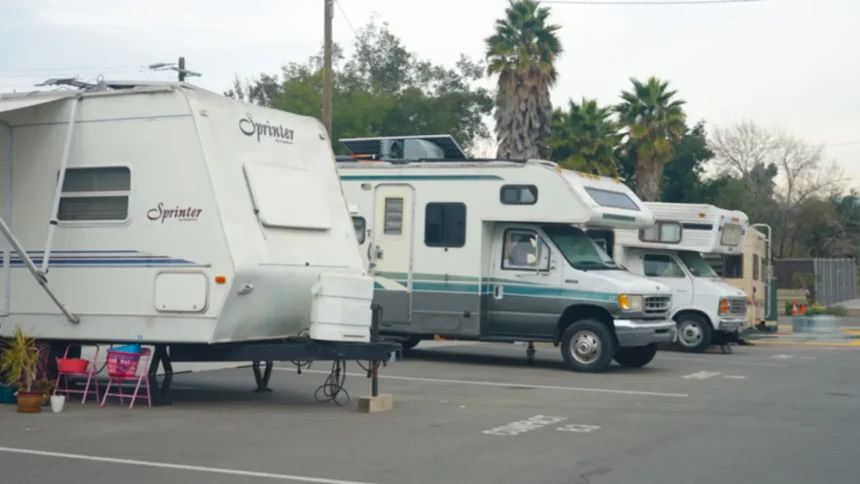
Recreational vehicles lining industrial corridors and residential streets across the Bay Area are no longer a fringe phenomenon – they are a visible indicator of structural housing imbalance. As NewsTrackerToday observes, the rapid increase in vehicle-based living in Santa Clara County reflects a deeper affordability fracture within one of the wealthiest technology hubs in the world. What appears to be a homelessness visibility issue is, in reality, a supply-and-access crisis shaped by years of underbuilding and rental inflation.
Since the pandemic, the share of unhoused residents sleeping in vehicles in Santa Clara County has more than doubled, rising from 18% in 2019 to 37% in 2025. California overall accounts for nearly a quarter of the nation’s homeless population while representing roughly 12% of the U.S. population. That imbalance highlights a structural mismatch between housing demand and available supply. Estimates suggest the state may require up to 3.5 million additional housing units to meet long-term needs – a gap that cannot be closed through short-term interventions alone.
Liam Anderson, NewsTrackerToday financial markets expert, interprets the surge in vehicle living as a predictable market outcome. “When rental growth persistently outpaces income growth, exclusion replaces access,” he explains. “Vehicles become an informal housing substitute for individuals who are employed but locked out of traditional leases.” From a financial perspective, this reflects pricing compression rather than labor-market collapse.
The appeal of vehicles lies in autonomy. Shelters, while essential, often impose restrictions on timing, storage, privacy and eligibility. For full-time workers, a vehicle offers mobility and control, however limited. Ethan Cole, chief economic analyst specializing in macroeconomics and central banking, argues that this shift marks a transformation in the composition of homelessness. “This is affordability-driven displacement,” he says. “When entry barriers – deposits, credit checks, income multiples – rise too high, even steady employment no longer guarantees housing stability.”
Yet scarcity has produced secondary distortions. A shadow rental market has emerged in parts of the Bay Area, where older RVs are leased on public streets without formal contracts or tenant protections. Lawmakers describe such arrangements as exploitative, but enforcement alone cannot eliminate them. As News Tracker Today notes, when formal supply fails, informal markets expand to absorb demand.
Municipal responses have varied. Some cities have intensified parking enforcement, issuing fines and impounding vehicles. However, Anderson cautions that confiscation often removes both shelter and economic mobility. “For someone living in a vehicle, that vehicle represents their primary asset,” he explains. “Destroying it compounds instability.” An alternative approach has gained traction in San Jose through structured “safe parking” programs that provide sanitation, case management and a pathway toward permanent housing. While these programs offer stability and oversight, capacity remains limited relative to demand. Cole emphasizes that transitional infrastructure can reduce volatility, but cannot replace large-scale construction and zoning reform.
Looking ahead, the trajectory will depend on policy sequencing. If enforcement outpaces housing expansion, vehicle-based living will likely circulate rather than decline. If cities align safe parking capacity with accelerated building approvals and rental assistance, growth could stabilize. Without structural supply expansion, RVs will continue serving as California’s informal housing buffer – a signal of economic divergence that NewsTrackerToday will continue to analyze as affordability pressures evolve.