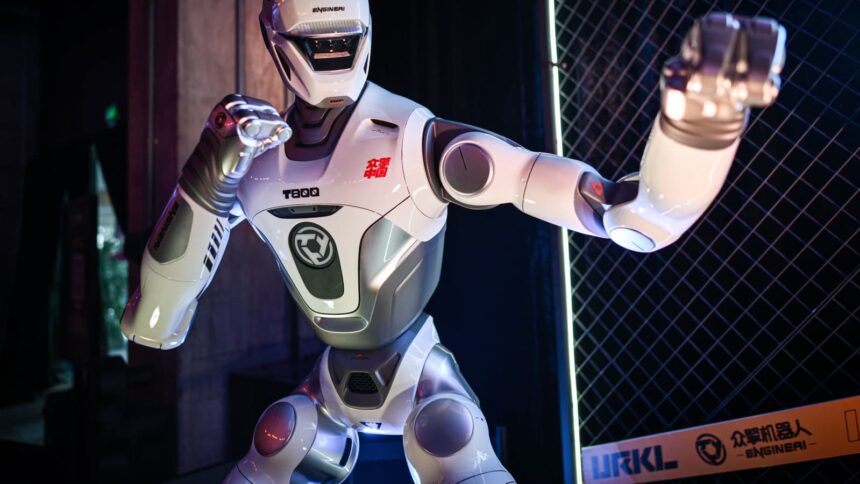
China’s humanoid robots moved from novelty to strategic signal during this year’s Spring Festival Gala, where machines performed kung fu sequences, synchronized choreography and complex acrobatics with a level of stability that sharply contrasted with last year’s tentative demonstrations. For NewsTrackerToday, the performance marked more than entertainment value – it indicated that China is positioning humanoid robotics as a scalable industrial platform rather than a research showcase.
Just twelve months ago, public trials of humanoids frequently went viral for the wrong reasons: stumbles, balance failures and mechanical breakdowns dominated headlines. The visible improvement this year suggests rapid iteration in actuator efficiency, torque density and AI-driven motion planning. What appears to audiences as smoother choreography typically reflects stronger joint engineering, improved battery optimization and reinforcement-learning systems trained in increasingly realistic simulations. In robotics, incremental refinements compound quickly once manufacturing pipelines stabilize.
China’s lead is already evident in production metrics. Industry estimates suggest that of roughly 15,000 humanoid robots installed globally in 2025, more than 85% were deployed in China, compared with around 13% in the United States. Liam Anderson, financial markets expert, interprets this as a supply-chain advantage rather than purely a design breakthrough. “China’s vertical integration – from rare earth materials and magnets to motors and battery systems – compresses both cost and iteration time,” he explains. “That gives domestic firms a structural head start in scaling.”
Pricing reinforces this edge. Some Chinese manufacturers are marketing entry-level humanoids at price points comparable to a mid-range vehicle, significantly lower than projected U.S. alternatives. Lower cost does not automatically equal commercial viability, but it expands access to research labs, universities and mid-sized industrial operators. As NewsTrackerToday has observed in adjacent hardware sectors, affordability often accelerates ecosystem growth, generating the data loops that improve software intelligence.
In the United States, Tesla’s Optimus remains the flagship humanoid initiative. Elon Musk has suggested that production costs could fall below $20,000 per unit at million-unit scale, though near-term pricing will likely remain higher. Ethan Cole, chief economic analyst specializing in macroeconomics and central banking, argues that manufacturing density will determine competitive endurance. “High-volume output flattens cost curves,” he notes. “The challenge for U.S. producers is replicating supply-chain concentration without equivalent industrial clustering.”
Still, shipment volume alone will not define leadership, as News Tracker Today has repeatedly emphasized in its coverage of emerging robotics markets. Analysts caution that humanoids must demonstrate reliability in unstructured, human-centered environments such as healthcare support, household assistance and dynamic factory floors. Acrobatics under controlled lighting do not equal eight hours of autonomous task execution. Cole emphasizes that sustained uptime, safe human interaction and multi-task chaining will determine economic value more than spectacle.
Artificial intelligence may ultimately become the decisive factor. Advanced reasoning models, contextual memory and real-time correction systems will shape a robot’s utility more than mechanical agility. Anderson adds that “the robot’s commercial ceiling depends on its cognitive architecture.” In effect, the competition may pivot from hardware dominance to software depth – from who builds the most dexterous body to who deploys the most capable mind.
Over the next 12 to 24 months, China is positioned to maintain cost and volume leadership, accelerating pilots across logistics, security and light manufacturing. U.S. firms are likely to emphasize AI integration, safety certification and enterprise deployment models.
The broader implications extend beyond engineering: humanoid robotics now sits at the intersection of industrial policy, AI rivalry and labor economics. While short-term adoption may alleviate workforce shortages in repetitive or hazardous roles, medium-term integration could reshape productivity structures.
Humanoid robotics is transitioning from spectacle to infrastructure. The Spring Festival demonstration showed measurable progress in physical control, but the long-term race will be decided by intelligence, reliability and scalable economics – developments NewsTrackerToday will continue to track as the balance between manufacturing scale and cognitive capability evolves.