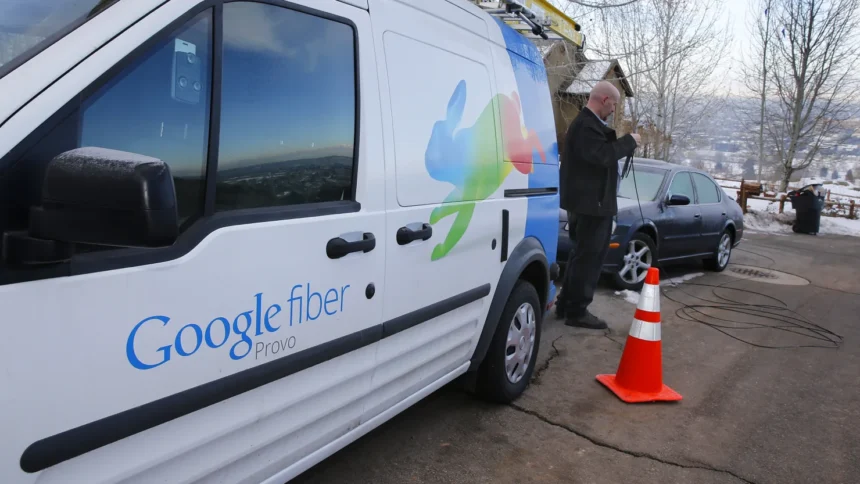
Google is restructuring its fiber broadband operations, spinning off the GFiber unit into a new company that will combine its network with Astound Broadband while leaving Google with a minority stake in the venture. The new provider will be backed by infrastructure investment firm Stonepeak and led by GFiber’s current management team. The move signals a shift in how major technology companies approach capital-intensive infrastructure projects – a development recently examined in reporting by NewsTrackerToday.
The transaction is expected to close in the fourth quarter, subject to regulatory approvals. By combining their networks and operational resources, the partners aim to expand fiber connectivity more quickly across U.S. markets where demand for faster broadband continues to accelerate.
Google Fiber itself began as one of the company’s most ambitious infrastructure experiments. Launched in 2010, the project promised gigabit-speed internet at a time when most American households relied on much slower broadband connections. Kansas City became the first deployment site in 2012, turning the initiative into a closely watched attempt to disrupt the U.S. internet market. Yet building fiber networks at national scale proved far more difficult than initially expected. The costs of construction, regulatory approvals, and local infrastructure work forced Google to slow its original rollout plans and focus instead on a smaller number of metropolitan markets where deployment conditions were more manageable.
Sophie Leclerc, technology sector analyst, says the renewed interest in fiber infrastructure reflects deeper structural changes in the digital economy. Artificial intelligence services, cloud computing platforms, and high-definition streaming all require increasingly large volumes of data to move across networks. That growing demand has attracted a wave of infrastructure investors into the connectivity sector. As News Tracker Today notes, financial firms specializing in long-term infrastructure assets have become increasingly active in broadband networks, data centers, and subsea cable systems.
GFiber has historically operated within Alphabet’s “Other Bets” division, which includes projects such as autonomous driving developer Waymo and AI drug discovery company Isomorphic Labs. In 2025 the segment generated $1.54 billion in revenue – less than half a percent of Alphabet’s overall revenue – while recording an operating loss of $16.8 billion. As NewsTrackerToday previously pointed out in its analysis of Alphabet’s experimental businesses, many of these initiatives are designed to pursue long-term technological bets rather than short-term profitability.
Daniel Wu, geopolitics and energy analyst, notes that communications infrastructure is becoming strategically important as global data traffic expands. Reliable high-capacity fiber networks increasingly underpin everything from cloud computing systems to artificial intelligence platforms. Astound Broadband, which will merge with GFiber in the new structure, is a major U.S. cable and broadband operator acquired by Stonepeak in 2021 for roughly $8.1 billion. Stonepeak specializes in large-scale infrastructure investments across sectors including telecommunications, energy, transport, and digital connectivity.
For Google, the arrangement allows the company to remain involved in the fiber broadband market while shifting the financial burden of expansion to an infrastructure-focused platform backed by outside investors. As NewsTrackerToday notes, similar partnership models are becoming more common as the cost of building next-generation digital networks continues to rise.