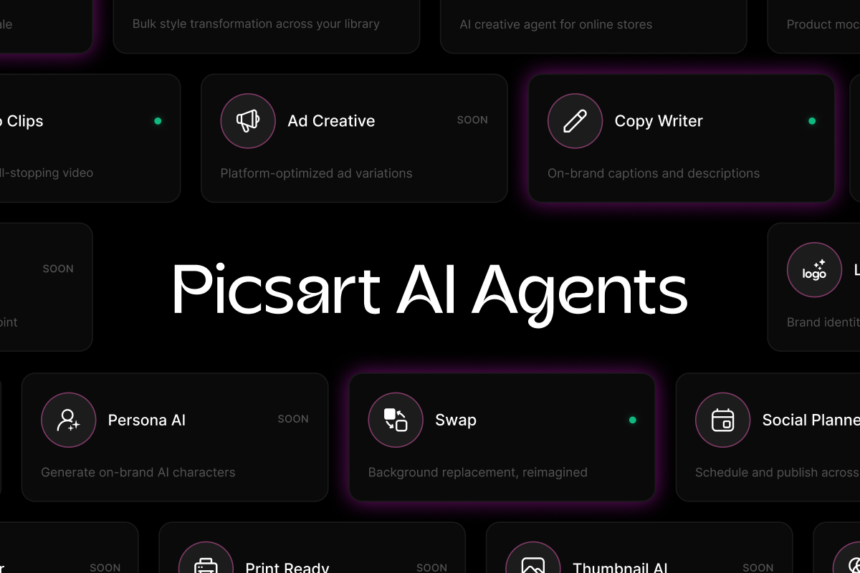
The shift from generative AI tools to task-oriented AI agents is beginning to reshape the creator economy, and Picsart is positioning itself directly within that transition. As NewsTrackerToday highlights, the company has launched an AI Agent Marketplace designed to let users “hire” specialized assistants that can execute specific workflows – from resizing content for social platforms to optimizing product visuals for e-commerce.
Picsart, which reports more than 130 million users globally, is leveraging its strong presence among Gen Z creators to expand beyond traditional design tools. The platform is introducing agents such as Flair, Resize Pro, Remix and Swap, each focused on a clearly defined use case. According to Sophie Leclerc, a technology sector analyst, this approach reflects a broader shift in product design across the industry. Rather than building general-purpose AI assistants, companies are increasingly deploying narrow, task-specific agents that directly address repetitive workflows.
One of the most strategically important elements is the integration of Flair with Shopify. The agent is designed not only to edit product images but also to analyze performance and suggest improvements. Over time, it is expected to support A/B testing and identify underperforming products. From a structural perspective, Isabella Moretti, a corporate strategy and M&A analyst, argues that this signals a move toward monetizable AI workflows. In her view, tools that directly influence sales outcomes – rather than just content quality – are far more likely to drive subscription revenue and long-term retention.
Picsart’s timing is also notable. The growing popularity of agent-based AI systems, fueled by viral platforms and increased enterprise experimentation, has created strong demand for tools that can execute multi-step tasks rather than simply generate outputs. As previously noted by NewsTrackerToday, this marks a broader transition across the AI landscape, where value is shifting from content generation to task execution and workflow automation.
Another key differentiator is distribution. Picsart plans to integrate its agents into messaging platforms such as WhatsApp and Telegram, allowing users to interact with them within existing communication environments. This aligns with a wider industry trend: AI adoption tends to accelerate when tools are embedded into привычные user workflows rather than requiring entirely new interfaces. According to Sophie Leclerc, this could significantly reduce friction in adoption, especially among creators who already manage content pipelines across multiple apps.
However, the model also introduces risks. AI agents built on large language models remain prone to hallucinations, unintended actions and context errors. Picsart addresses this by introducing adjustable autonomy levels, allowing users to require approval before agents execute tasks. While this hybrid approach improves reliability, it also highlights a broader limitation of current agent-based systems – full autonomy remains difficult to trust in production environments.
Security is another critical factor. As agents gain access to platforms like Shopify, media libraries and messaging tools, the potential impact of errors or vulnerabilities increases. From a structural standpoint, News Tracker Today notes that trust, permissions management and transparency will become key competitive factors as agent-based ecosystems expand.
From a business model perspective, Picsart is following a familiar freemium strategy. Basic usage is supported through limited AI credits, while more advanced functionality – including full agent usage – is tied to paid subscriptions starting at around $10 per month. According to Isabella Moretti, this reflects the underlying economics of AI infrastructure, where compute-intensive services cannot be sustainably offered at scale without monetization tied to productivity gains.
At a broader level, Picsart’s move reflects a transformation in how creative platforms are evolving. The competitive landscape is shifting from tools that enable creation to platforms that orchestrate entire workflows. This means competition will increasingly focus on automation efficiency rather than purely on design capabilities.
The key question going forward is whether these agents can deliver consistent, measurable value. As NewsTrackerToday concludes, long-term success will depend on three factors: the ability of AI agents to meaningfully reduce time spent on repetitive tasks, the reliability and safety of their actions within real-world workflows, and their impact on tangible outcomes such as engagement, output volume or conversion rates. If these conditions are met, agent marketplaces could become a defining layer of the next generation of creator tools.