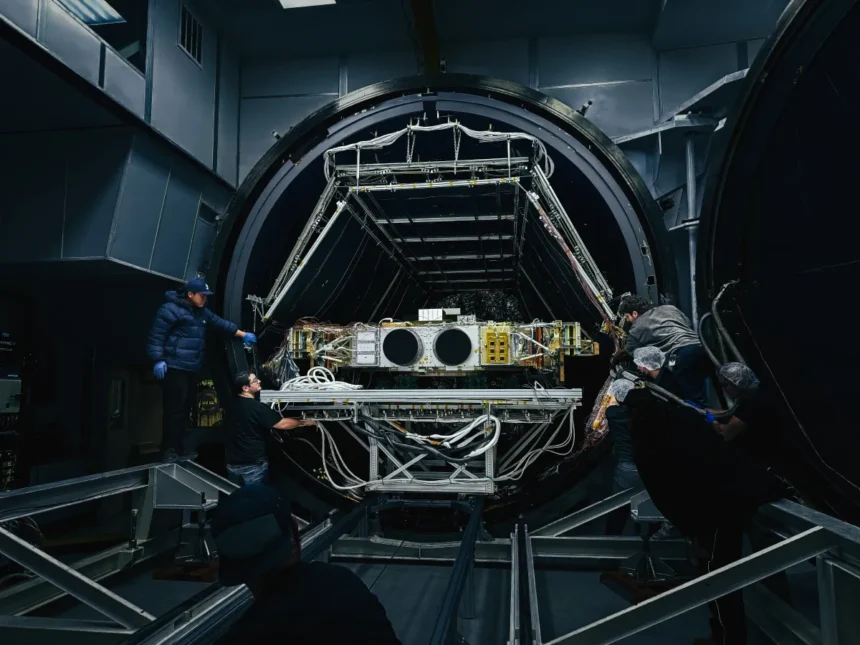
K2 Space’s upcoming launch of its Gravitas satellite represents more than a technical milestone – it reflects a broader shift in how the space industry is rethinking power, scale, and orbital infrastructure. The two-ton spacecraft, set to launch on a Falcon 9 in the coming weeks, is designed to generate up to 20 kW of power – placing it closer to traditional high-capacity satellites than to the smaller, cost-optimized platforms that have dominated the market. As NewsTrackerToday notes, this signals a transition from “cheap and small” toward “power-dense and scalable” systems.
At the core of K2’s strategy is a simple premise: in orbit, power is the primary constraint. According to Sophie Leclerc, a technology sector observer, higher onboard energy directly expands capabilities – from bandwidth to real-time data processing. In her view, K2 is redefining value in space around usable power rather than hardware size.
Gravitas is structured as a multi-layered demonstration. It will carry 12 payloads, including defense-related modules, alongside a 20 kW electric propulsion system – potentially the most powerful deployed in orbit. This allows K2 to test deployment, energy generation, payload performance, and orbital maneuvering simultaneously. While this accelerates validation, it also concentrates risk, making data collection the key success metric.
Financially, K2 has raised around $450 million and reached a valuation of $3 billion. Liam Anderson, a financial markets expert, notes that this reflects belief in a structural shift – but also raises expectations for execution beyond prototypes.
Launch economics remain a key uncertainty. K2’s long-term vision depends on future heavy-lift systems like Starship, but for now the company must prove viability using Falcon 9 pricing. Isabella Moretti, a corporate strategy analyst, sees this as a necessary reality check: if the model doesn’t work under current conditions, it remains speculative.
K2 argues its platform is already competitive, with a ~$15 million satellite and ~$7 million launch cost delivering strong performance relative to traditional systems. NewsTrackerToday highlights that cost per unit of power is the company’s core differentiator – though this still requires validation through reliability and customer demand.
Demand trends support the thesis. Growth in communications, defense, and onboard processing is increasing the need for higher power in orbit, suggesting that power-intensive platforms could gain relevance across sectors.
However, orbital data centers remain a long-term concept. While more powerful satellites enable greater onboard computing, significant technical and economic barriers remain. K2’s approach is therefore foundational rather than final. The company’s high level of vertical integration – designing most components in-house – offers cost and speed advantages but increases engineering risk. Still, this aligns with a broader trend among space startups toward tighter control over production.
K2 is already exploring larger platforms, including concepts up to 100 kW, positioning itself ahead of future infrastructure shifts. As Sophie Leclerc notes, this strategy is both an opportunity and a gamble, dependent on timing.
The outlook remains cautiously optimistic. If Gravitas delivers and K2 executes its planned launches over the next two years, it could emerge as a key player in high-power orbital systems. But execution risk remains high. News Tracker Today highlights three key indicators to watch: mission performance and data yield, launch cadence, and the ability to secure contracts under current economics. These will determine whether K2 is building the next standard in space infrastructure – or advancing a compelling but unproven vision.