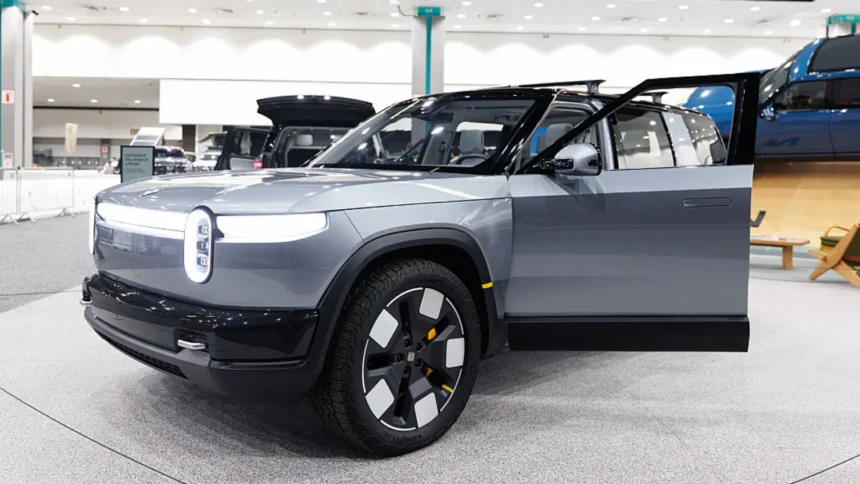
Uber’s planned investment of up to $1.25 billion in Rivian marks a significant escalation in the race to commercialize autonomous mobility, as companies shift from experimentation toward structured, large-scale deployment strategies. The agreement, which envisions up to 50,000 robotaxis by 2031, signals that industry players are no longer testing isolated pilots but actively building long-term ecosystems. As reflected in the broader market narrative, NewsTrackerToday highlights that this deal is less about a single product and more about positioning within a multi-trillion-dollar mobility transformation.
At the core of the partnership is a staged investment structure, beginning with an initial $300 million and expanding through milestone-based tranches tied to Rivian’s progress in autonomous technology. This approach reduces upfront risk while enforcing execution discipline. According to Isabella Moretti, an analyst specializing in corporate strategy and M&A, such structures indicate a shift toward performance-linked capital deployment in emerging technology sectors. In her view, Uber is deliberately avoiding the mistakes of earlier AV investments, where capital was committed ahead of technological readiness.
Rivian’s R2 platform plays a central role in this strategy. Designed as a more scalable and cost-efficient vehicle compared to earlier models, it is expected to serve both consumer and commercial use cases. From a financial standpoint, Liam Anderson, a financial markets expert, notes that transforming a consumer EV platform into a robotaxi backbone could significantly improve unit economics – if utilization rates and operational uptime meet expectations. However, he also emphasizes that this dual-purpose strategy increases execution complexity, particularly in aligning hardware production with autonomous system readiness.
Beyond the vehicle itself, the partnership reflects a broader structural shift in how autonomous mobility is being built. NewsTrackerToday underscores that Uber is reinforcing its role not as a developer of autonomous systems, but as an aggregation layer connecting fleets, software providers, and end users. This multi-partner approach allows Uber to scale supply without bearing the full cost of technological development, a model that contrasts with vertically integrated competitors.
At the same time, Rivian faces a more capital-intensive path. Expanding into autonomy requires sustained investment in software, data infrastructure, and specialized hardware, all while maintaining core manufacturing operations. The company’s previous delays in achieving profitability highlight the financial pressure associated with this transition. NewsTrackerToday notes that while the deal strengthens Rivian’s long-term positioning, it also raises expectations for near-term execution and operational consistency.
From an industry perspective, demand drivers appear aligned with the strategy. Growth in urban mobility services, logistics automation, and AI-driven fleet management is increasing the need for scalable autonomous platforms. However, commercialization timelines remain uncertain, particularly given regulatory hurdles and the technical challenges of achieving reliable, large-scale autonomy. In this context, partnerships like Uber and Rivian’s represent a pragmatic pathway – combining distribution, manufacturing, and technology into a shared framework.
What ultimately matters is execution. News Tracker Today points to three critical indicators: Rivian’s ability to deliver a fully autonomous R2 platform on schedule, Uber’s capacity to integrate these vehicles into a functioning multi-city network, and the overall cost structure of operating robotaxi fleets at scale. If these elements align, the partnership could define a new standard for the industry. If not, it risks becoming another ambitious but premature attempt to industrialize autonomy.