The rise of AI-powered note-taking tools is increasingly defined by a structural divide between cloud-based platforms and local-first alternatives. Talat, a new Mac application, enters this space with a clear thesis: sensitive audio data should not leave the user’s device. As NewsTrackerToday notes, this positioning reflects a broader shift in user expectations, where privacy is becoming a primary feature rather than a secondary consideration.
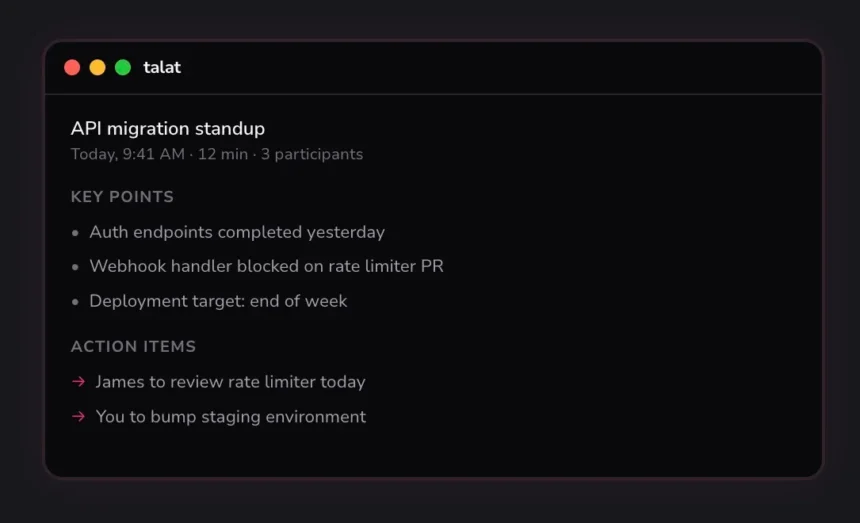
Talat is built as a fully local AI note-taking system, capturing system audio during calls and generating real-time transcripts and post-meeting summaries without requiring cloud processing. The product avoids accounts, subscriptions, and external data storage, instead offering a one-time purchase model. This approach directly contrasts with leading platforms such as Granola, which rely on cloud infrastructure and subscription-based monetization. From a product strategy perspective, this is not simply a pricing difference – it represents a fundamentally different trust model.
The technical foundation of Talat reinforces this positioning. The application leverages Apple’s Core Audio capabilities alongside a local processing framework that enables transcription and summarization directly on Apple Silicon devices. Sophie Leclerc, a technology sector analyst, notes that the increasing performance of on-device AI chips is enabling a new category of applications where latency, privacy, and cost efficiency can be optimized simultaneously. In this context, Talat is aligned with a broader industry movement toward edge computing.
Flexibility is another defining element. Rather than locking users into a single AI model, Talat allows customization of the model stack, including local and optional external integrations. This modular approach reflects a growing preference among advanced users for control over how AI systems operate and where their data is processed. NewsTrackerToday highlights that such configurability is becoming a differentiator in productivity tools, particularly among technical and privacy-conscious audiences.
However, the competitive landscape remains challenging. Cloud-based platforms are rapidly expanding beyond transcription into collaborative knowledge systems, integrating with enterprise workflows and enabling shared access to insights across teams. Ethan Cole, a macroeconomic analyst focusing on digital productivity trends, points out that these network effects create strong retention dynamics. Local-first tools, while strong in privacy, may face limitations in collaborative environments where shared data and centralized processing are essential.
The choice of a one-time payment model introduces both opportunity and risk. It addresses growing fatigue with subscription-based software and may attract users seeking cost predictability. At the same time, AI products require continuous updates, model improvements, and infrastructure evolution. Sustaining long-term development without recurring revenue streams could become a constraint as the product matures.
From a market perspective, Talat is entering a rapidly expanding segment. Enterprise and individual spending on generative AI applications has been increasing, particularly in tools that automate knowledge capture and workflow documentation. Daniel Wu, a geopolitical and infrastructure analyst, notes that the next phase of AI adoption will not be driven solely by model capability, but by how effectively these tools integrate into everyday workflows while respecting data sovereignty.
Talat’s current positioning suggests a focused rather than expansive strategy. Instead of competing directly with full-scale enterprise platforms, it targets users who prioritize control, privacy, and local processing. This includes founders, developers, investors, and professionals working with sensitive information. News Tracker Today emphasizes that success in this niche will depend on whether the product can evolve into a reliable standard for local-first productivity without attempting to replicate cloud-based ecosystems.
Looking ahead, the trajectory of Talat will depend on its ability to expand integrations, maintain performance across devices, and balance simplicity with functionality. NewsTrackerToday notes that the broader significance of this product lies in what it represents: a shift toward user-controlled AI environments, where ownership of data becomes a defining factor in product adoption and long-term trust.